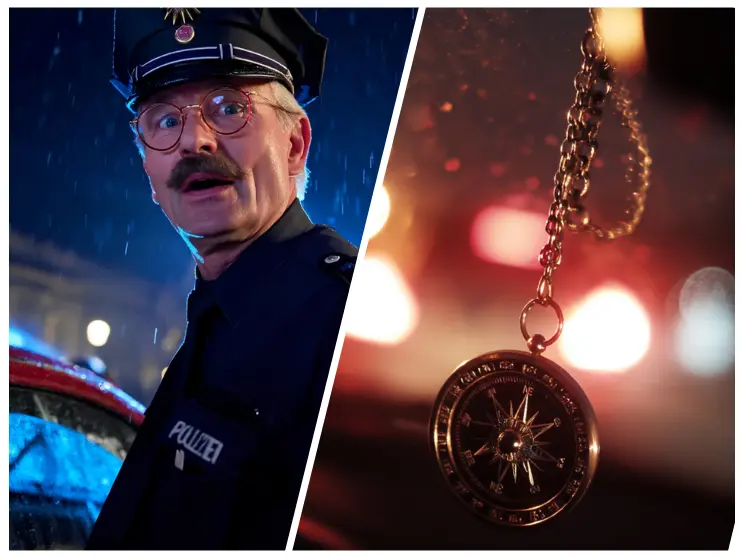
Rain slicked the road as Cole Vance slowed on the side of an old stolen sedan at a red light on the bypass. The driver turned his head slightly. Vance’s breath caught. The face wasn’t identical, but close enough to hit the same nerve and pull him back two years.
Before he could blame exhaustion or old grief, Vance’s gaze stuck on something dangling right above the dashboard. Hanging from the rearview mirror was a small metal compass keychain, dull with scratches. His chest tightened. He knew its weight and shape. He had held it once.
That compass should’ve been in Adam’s car the night he died, but it had never been found. Certainty slipped away. He flipped on his lights and stepped out, already knowing this stop would not end like a normal arrest for an auto theft…
Two years earlier, the arguments had started small, over late nights and unexplained money. Vance noticed new shoes, a new phone, and only a small job at a garage. Adam joked, dodged, and changed the subject. Vance recognized the signs from work. It hurt more to see them at his own table.
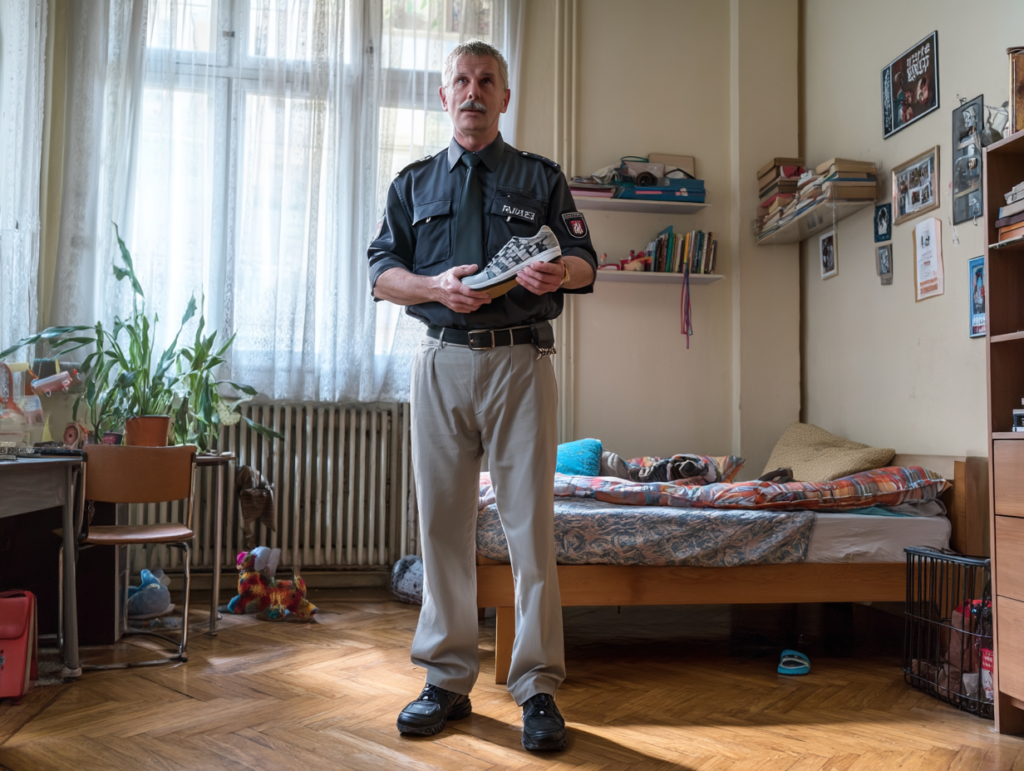
Being a cop made it worse. Everything Adam told sounded like a statement from a suspect. Every half-truth echoed interviews from kids who later ended up in files and cells. Vance didn’t know how to be both a father and an officer. He usually chose the officer.
“Are you drifting into something bad, Adam?” he had asked straight one night, standing in the hallway with his coat still on. Adam stood near the door, defensive and too calm. “No, I swear I just drive. I don’t think I have to moralize the people I drive around, ” he replied.
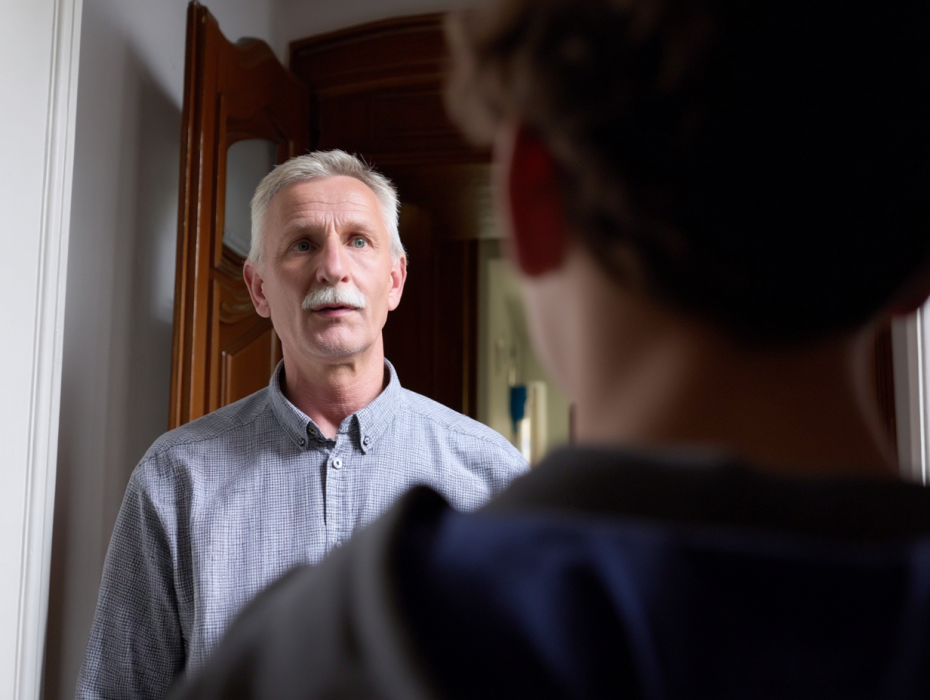
“Small wrongs eventually become big charges,” Vance said. “You may think petty stuff won’t harm, but…” Adam rolled his eyes. “I’ve no idea what you’re preaching about,” he shot back. Vance closed his mouth because he didn’t know how to proceed when his son outright rejected every advance at good advice.
The work stories seeped into their home. Vance talked about the wrong crowd, slippery slopes, and bad endings. Adam heard judgment, not concern. “You only see people at their worst,” Adam said. “You forget that some of us can’t find a proper job in this economy. I’m just doing whatever to help out with the finances.”
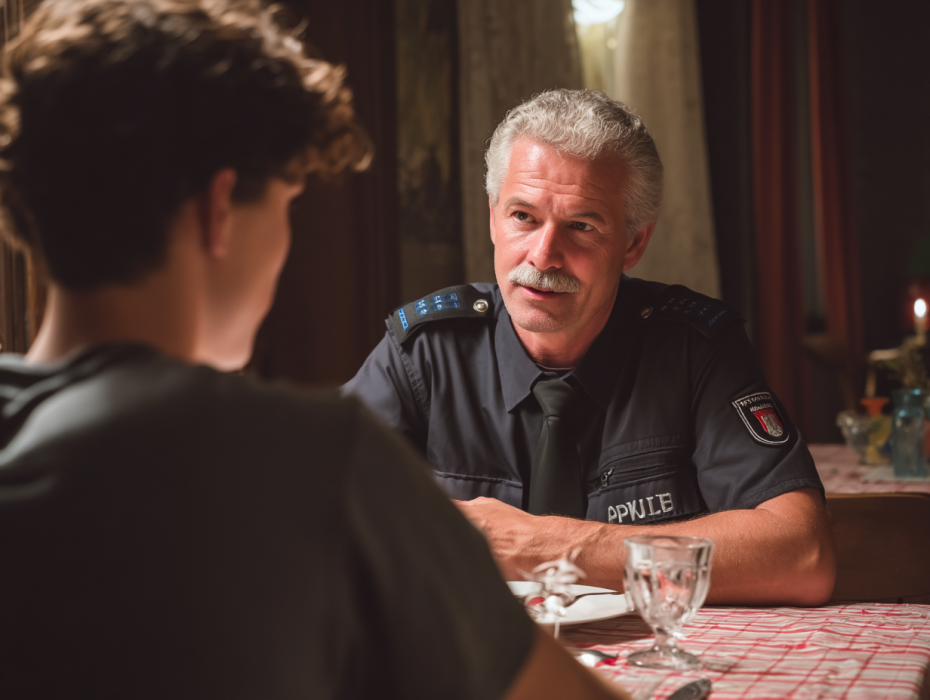
They had repetitions of the same conversation in different words for months. Vance tried to broach the subject indirectly. Adam shrugged them off. Some nights ended in slammed doors, and others in silence. Neither knew how to step out of their assigned roles—cop and suspect, not father and son.
One evening, the tone shifted. Adam said, “I’ve got a driver job tonight. Just a run. In, out, nothing crazy.” Vance felt every muscle tighten. The word “driver” sounded like every bad decision he’d ever documented. “Who for?” he asked. Adam replied, “Just a guy around my age.”
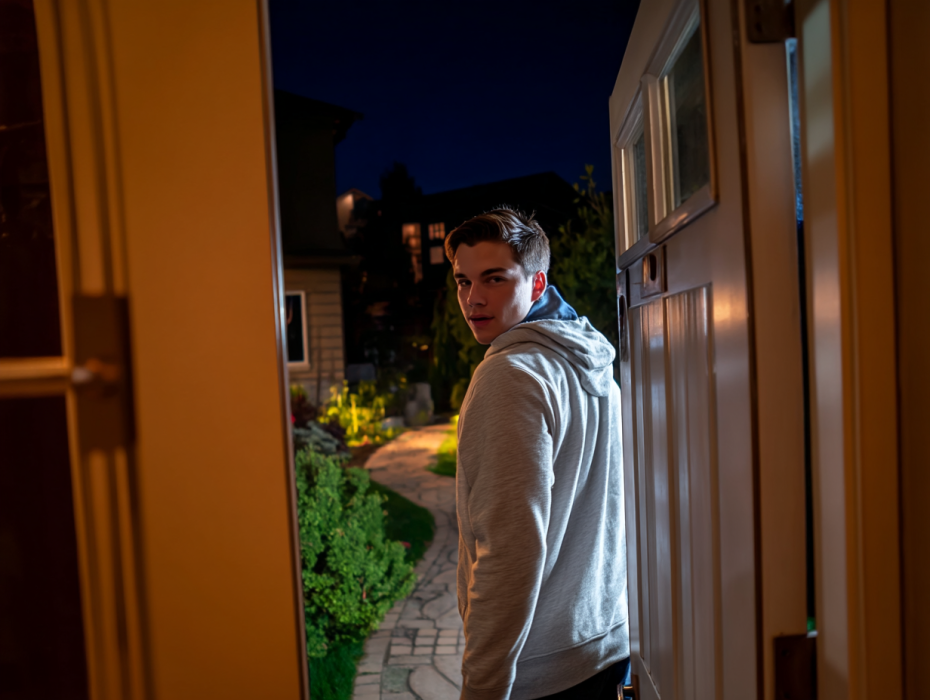
“Name?” Vance pressed. Adam shook his head. “Doesn’t matter. You don’t know him.” That alone told Vance enough. “If you can’t tell me his name, he’s not worth trusting,” Vance said. Adam stared back. “You don’t trust anyone who isn’t wearing your badge.”
Vance tried again. “This isn’t a traffic court. People get into trouble merely for being in the wrong place. You know that.” Adam looked down at his hands, then up. “I’m not robbing anyone,” he said. “I’m just the wheel. Then I’m out.” Vance heard a trap opening.
“Adam, you think you’ll remain unnoticed?” Vance asked. “Once you’re useful, they don’t let go.” Adam’s jaw tightened. “You never see me as anything except a future report,” he said. “You don’t actually believe I could do anything properly or honestly.”
The tension drained, not because they agreed, but because they were tired. Adam reached into his jacket and took out the compass keychain. He rolled it between his fingers. “I keep this to remember I’m not lost,” he said. “Even when you think I am.”
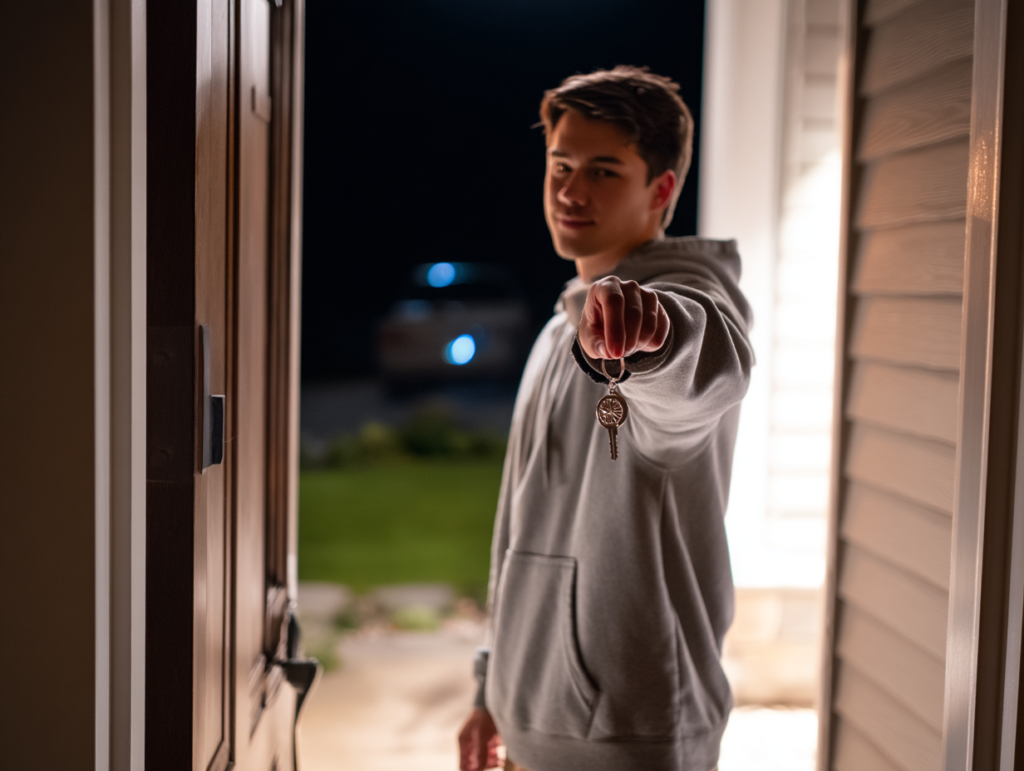
Vance remembered giving it to him years earlier, a small gift meant as encouragement, not a lifeline. “At least be careful,” he said. It was weaker than he wanted it to be. Adam gave him a small, sad smile. “I am,” he said. “You just never trust me.”
“That’s not what I—” Vance started, but Adam had already opened the door. “You’ll see,” Adam said over his shoulder. “I’ll make you proud yet.” He stepped into the hallway without looking back. The lock clicked. It sounded more final than either expected.
That was the last time Vance saw his son alive. He heard about the crash hours later: a car smashed against the barrier near the bypass with no other vehicle at the scene. The report called it a single-car accident. Driver error. End of file.
The compass wasn’t listed among Adam’s belongings. Neither was his wallet or phone. His questions met vague shrugs. “Must’ve been thrown clear,” someone said. “Things go missing.” Vance knew better. He had worked too many scenes. He felt something was off, but couldn’t prove it, much as he tried.
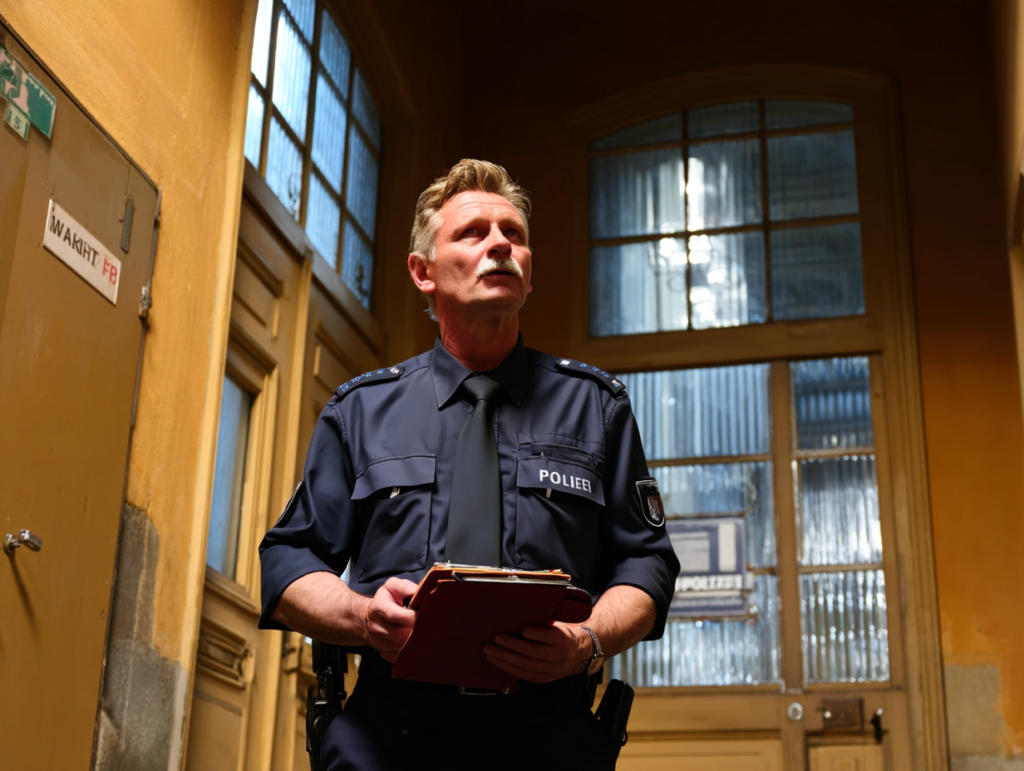
For two years, Vance balanced rage and shame. He blamed himself for not trying hard enough, for not reaching his son sooner. He also cursed the nameless person who had pulled Adam into something that had turned out tragic. The guilt sat between them, even with one of them gone.
Now, standing on the wet roadside, Vance felt that old weight surge back. The compass swung gently on the stranger’s dashboard. The past had caught up to him in metal and rain. Whatever waited next, he knew this stop was tied to Adam in a way he hadn’t seen coming.
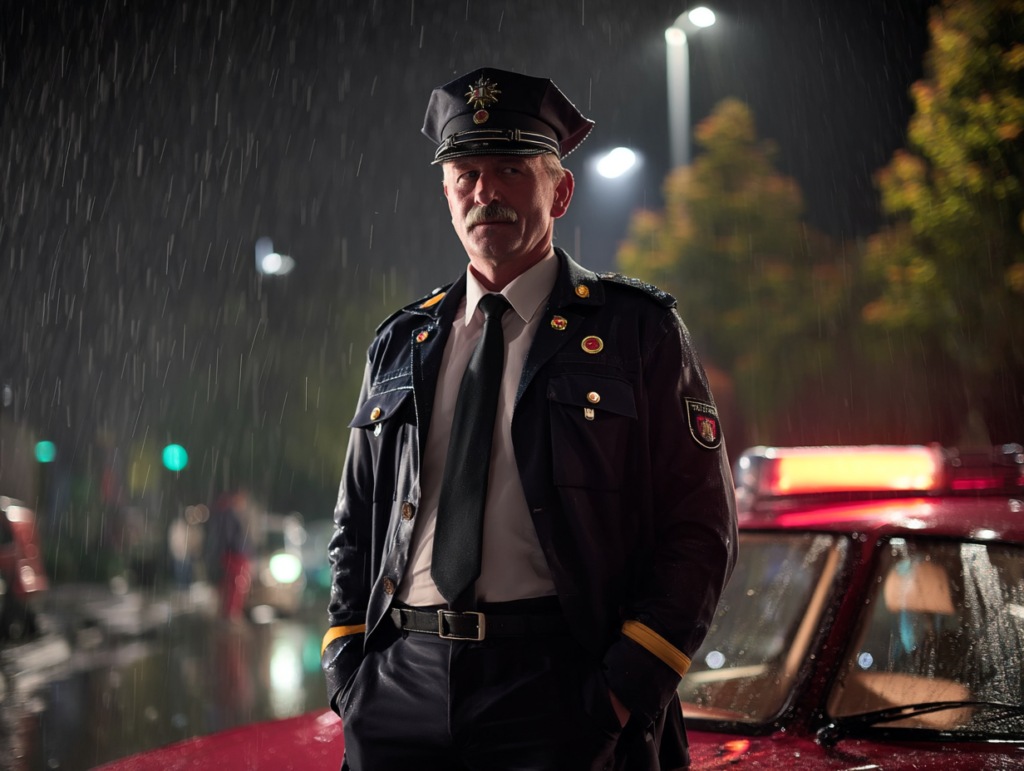
The sedan idled on the shoulder, wipers smearing rain in slow arcs. The driver kept both hands visible. Up close, he looked younger than Vance had first thought. Late-twenties. Tired eyes. Not Adam—but similar enough that the first look cut deep.
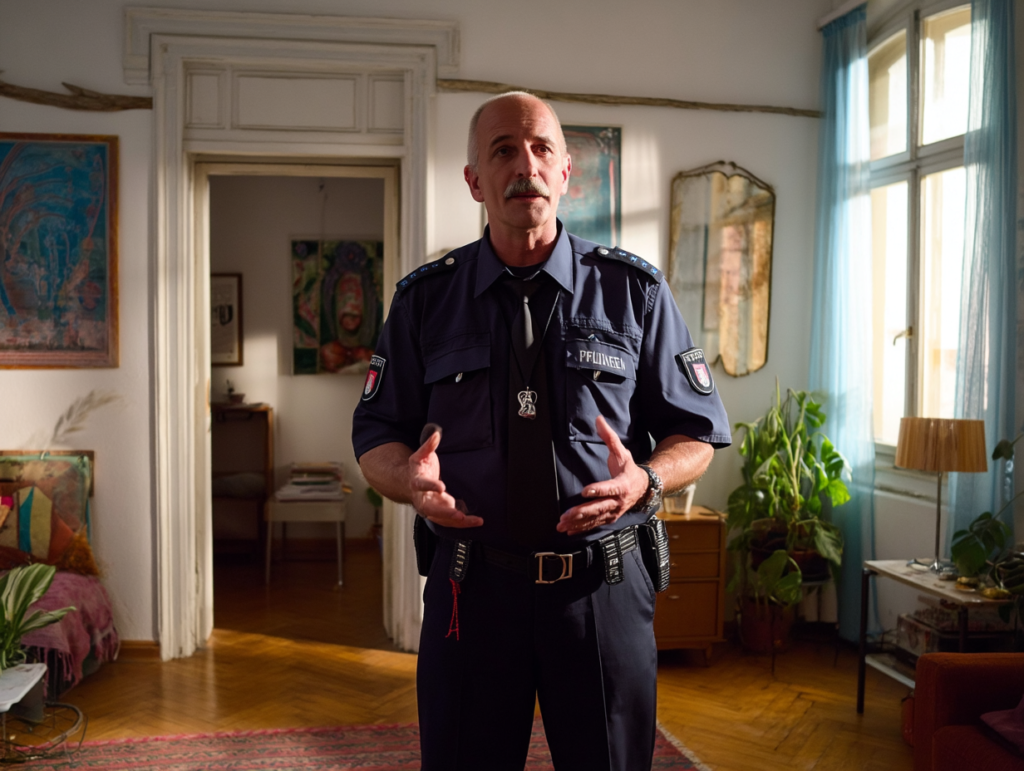
Vance walked up to the window. “Evening,” he said. His voice sounded calmer than he felt. The driver nodded. “Evening, Officer.” His tone was cautious but not hostile, like a man who had practiced being polite to authority.
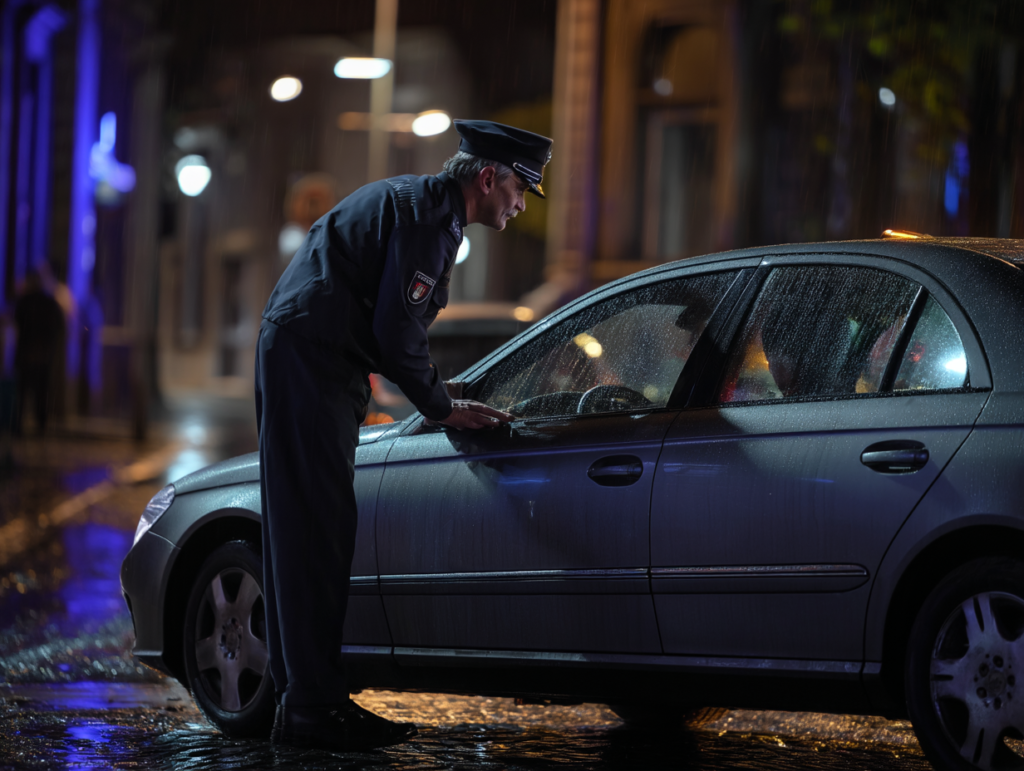
“Do you know why I pulled you over?” Vance asked. The driver shook his head. “No, sir. I don’t think I did anything wrong.” His voice carried something else under the words—a worry that had nothing to do with speeding.
“License and registration, please,” Vance said. The line was familiar, but his focus was split. The driver moved slowly, careful not to startle. He handed over the documents. Vance scanned them automatically. The forgery was a good attempt, but Vance saw through it.
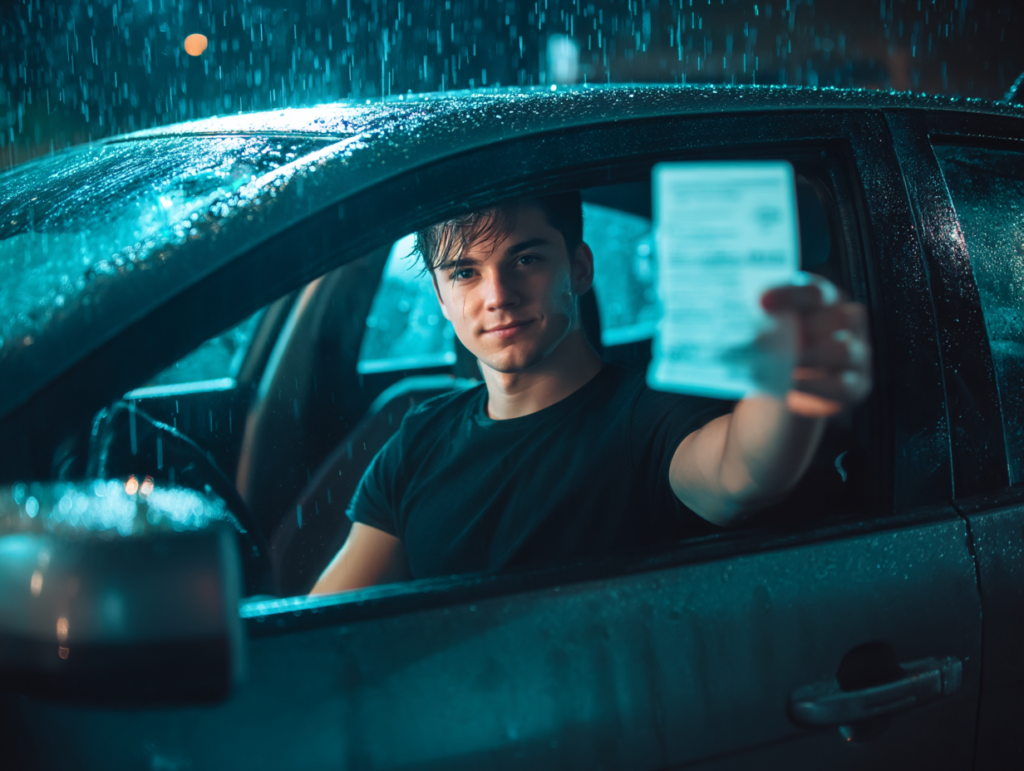
Liam Cross. The name on the license was unfamiliar. Vance said it aloud once. He watched the driver’s face. There was a flicker—fear, recognition, guilt, maybe all three. “I don’t know why I have been stopped,” Liam said, as if on cue. However, Vance caught his strange, steely stare.
“Where are you headed, Mr. Cross?” Vance asked. “Home,” Liam said. “Late shift at the shop.” His jacket carried a garage logo. His hands were rough, nails dark with grease. On the surface, he matched the life he described.
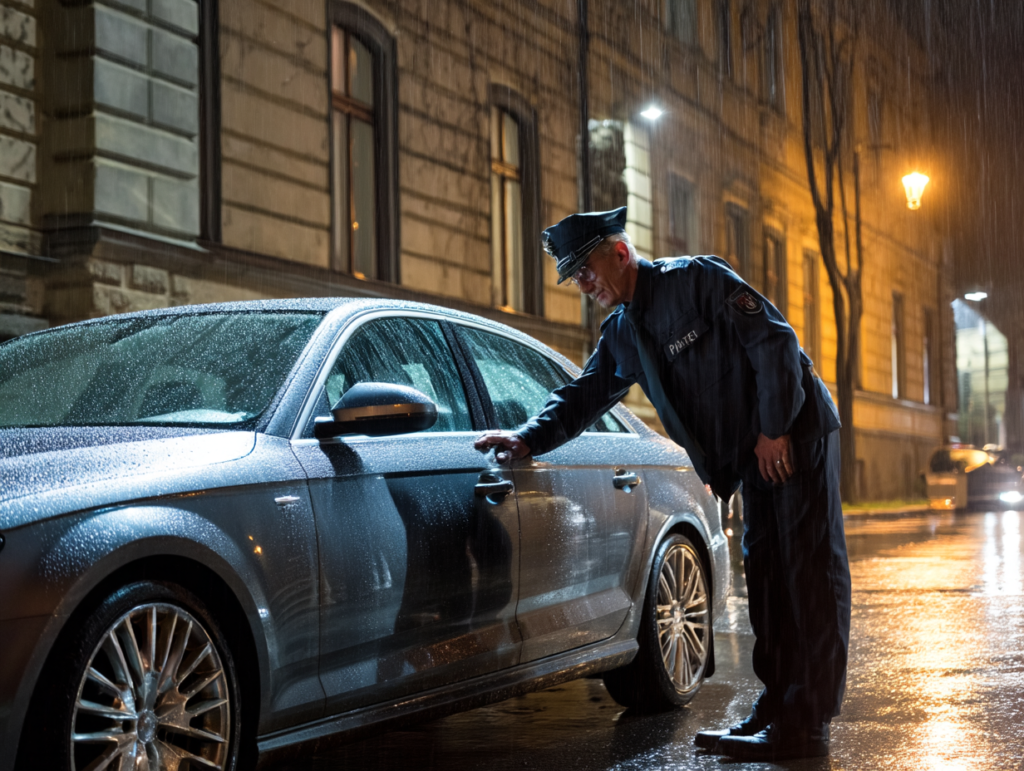
Vance handed the documents back, but didn’t step away. The compass keychain caught his eye again. “Where did you get that?” he asked, nodding toward the dashboard. Liam’s fingers twitched on the steering wheel.
He didn’t answer right away. He looked from the compass to Vance, measuring something. “That?” he finally said, though he seemed to clearly know. The delay told Vance this wasn’t just a lucky find at a pawn shop.
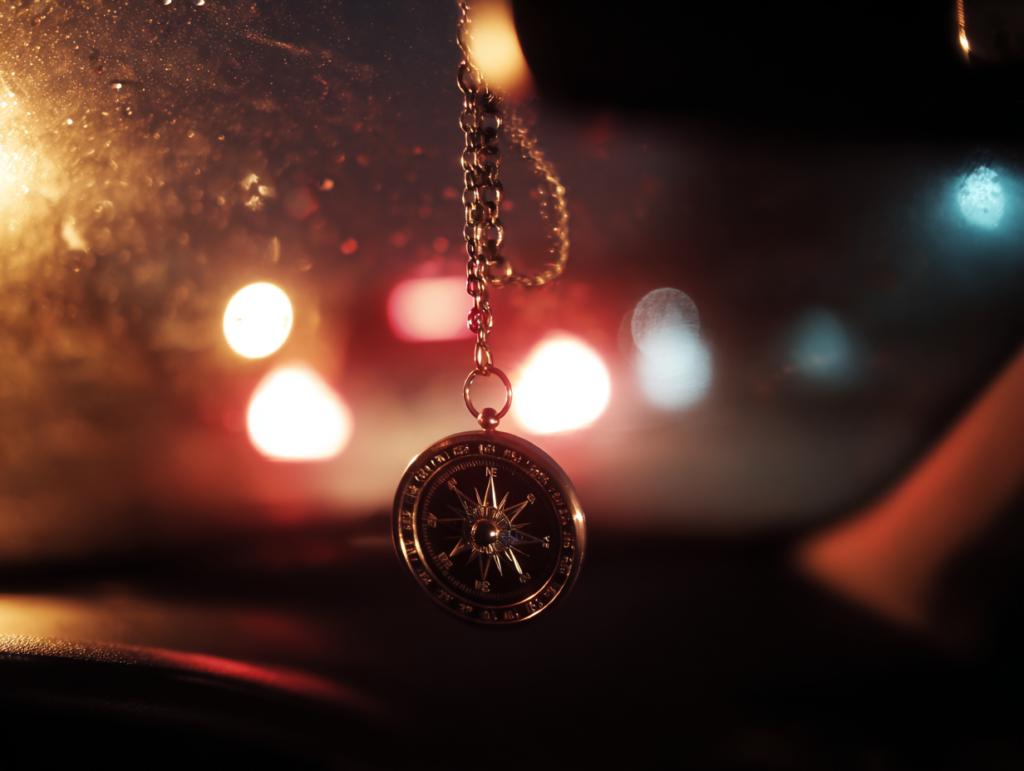
“Yes,” Vance said. “That.” His voice sharpened. The rain on the roof sounded louder. Liam exhaled slowly. “It was a…gift…from a friend,” he said. The pauses were almost deliberate. Vance saw that the younger man was nervous now, sweating profusely.
“Well, who is this friend?” Vance asked. Liam swallowed hard. “Hard to tell, it was a couple of years ago, can’t remember exactly,” he said. He reached up, unhooked the compass, and held it out through the window. “You can have it, officer.”
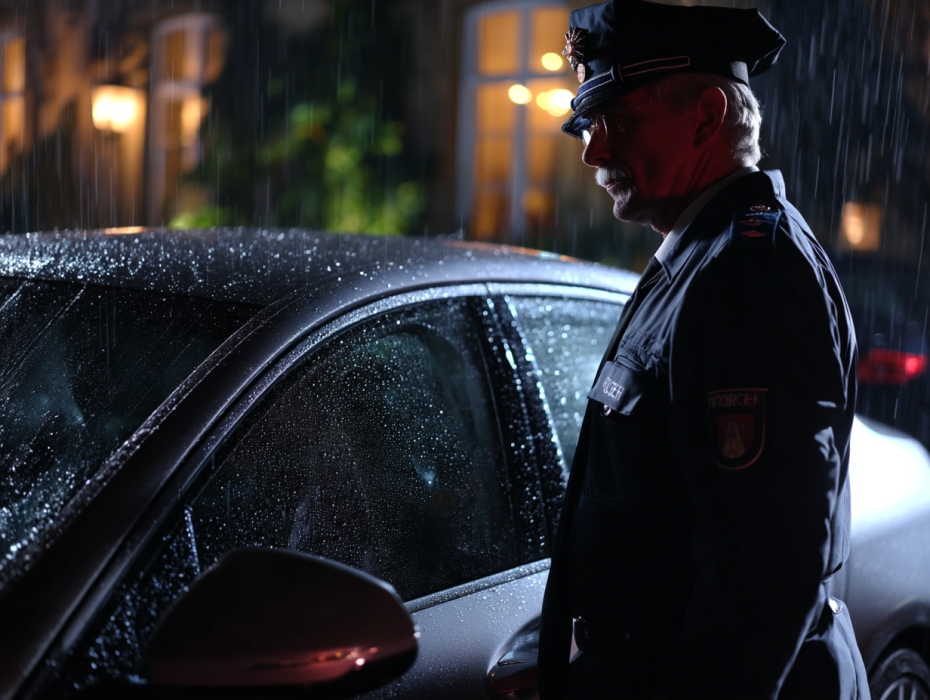
Vance took it. The metal was cold, heavier than he remembered. Every scratch, every dent matched the one he’d given Adam. “You knew my son,” he said. It came out as fact, not a question. He added, “I also know that this vehicle was listed as being stolen. You’re coming with me to the station.”
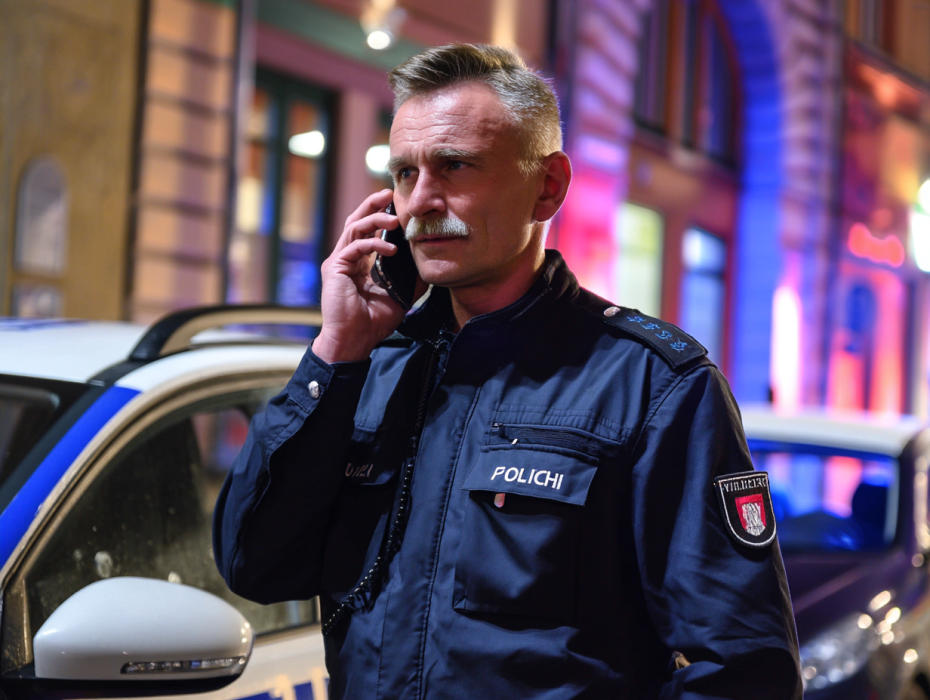
He handcuffed Liam and guided him to his cruiser, then called in the stop as routine, nothing special. No names. No details. Just a time and location that sounded like every other night. “Don’t try anything funny,” he told Liam. “Believe me, you don’t want to risk it.”
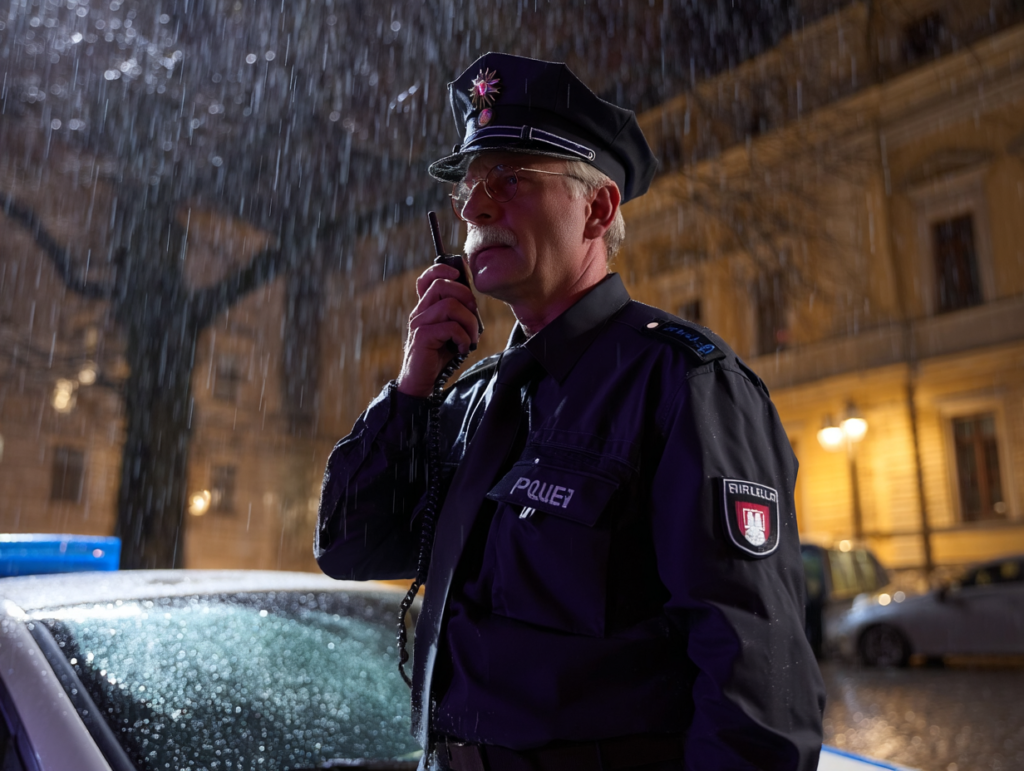
They drove to the station in silence, rain following them like a curtain. In an interview room, Vance set the compass at the center of the table. “Start from when you met him,” he said. Liam stalled a bit. Vance prepared to take notes, not as a father, but as a detective.
Liam’s shoulders finally slumped. At first, it seemed like he was going to deny everything, but Vance saw the dejection seep through him. “Yeah,” he answered quietly. “I did know him.” He looked away. “I was the one who got him that job.” The sentence landed harder than any punch.

“What job?” Vance asked sharply. He already knew the answer would cover more than driving. Liam stared at the rain sliding down the windshield. “Moving stuff,” he said. “Not illegal, exactly. But stuff that shouldn’t be on the market. Cash, small packages. I told him it was easy money.”
Vance felt his jaw tighten. “You dragged him into your mess.” Liam shook his head weakly. “Look here, you can’t pretend he wasn’t some innocent kid,” he replied. “He knew the kind of work I did. He chose it too. But I suppose he didn’t choose how it ended.”
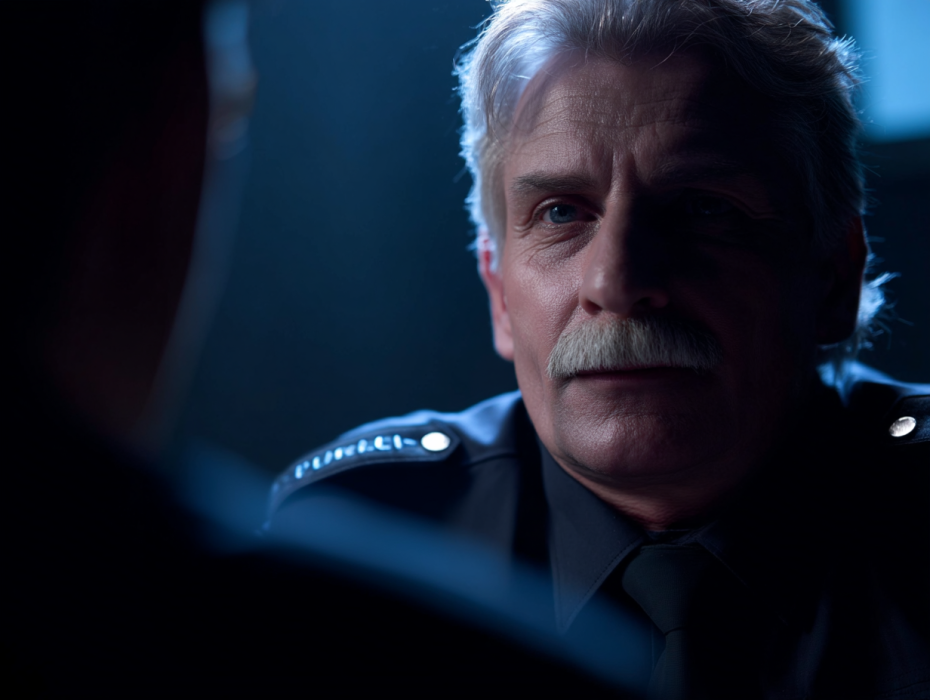
“Explain,” Vance said. The word felt heavy and final. Liam’s eyes closed briefly. “The night he died,” he said, “he drove my usual car. Same route. At the same time. I was supposed to be behind that wheel.” Vance felt his heart hammer.
“You traded places?” Vance asked at last. Liam nodded. “I told him I was tired. Asked him to cover. Promised it was a simple run. In and out.” He swallowed. “I didn’t tell him someone was probably watching that car.”

Vance’s hands curled around the compass. “Who was watching?” he asked. “People I shouldn’t have crossed,” Liam said. “Suppliers. They thought I’d skimmed. They were right.” He gave a short, bitter laugh that disappeared quickly.
“They tailed my car,” Liam continued. “Not the driver. They didn’t check who it was. And I suppose you saw the similarity between Adam and me just now. They just waited for the right stretch of road.” His voice dropped. “You know the rest.”
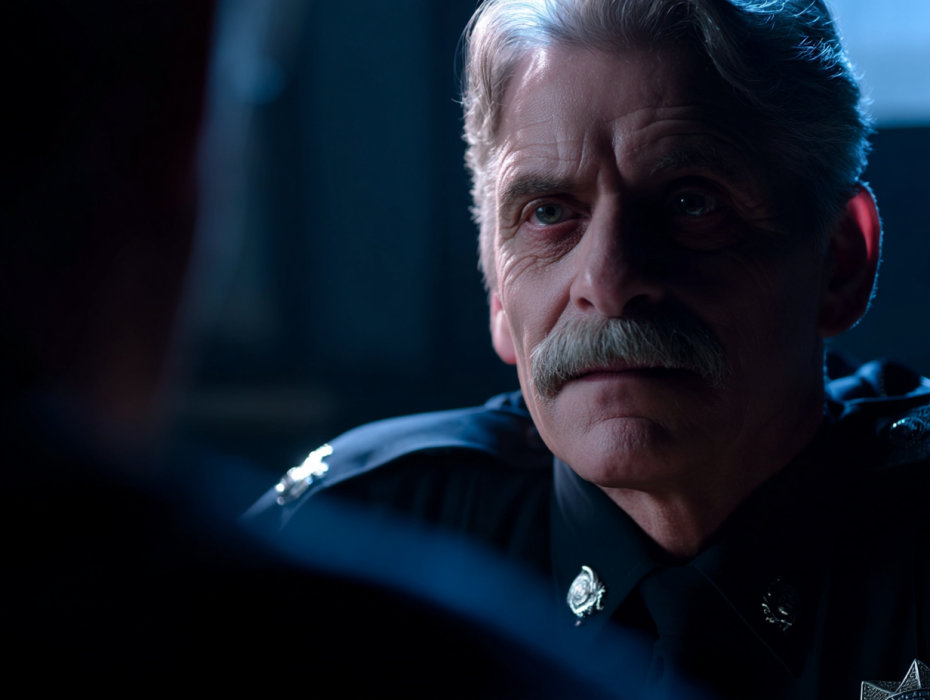
Vance saw it all again—the crushed metal, the clean report, the missing items. Only now the scene had context. Adam, driving a car meant for someone else. A hit disguised as bad weather and carelessness. He felt anger and bitterness bubble up.
“You set him up,” Vance growled. Liam flinched. “I didn’t mean to,” he replied. “I thought they might scare me. Slash the tires. Rough me up. I didn’t think they’d take the whole car out. I swear. Adam was my friend, even if you don’t believe it. The whole thing has dogged me for all this while.”

“You knew there was a risk,” Vance pressed. “And you let him go!” Liam nodded miserably. “I told myself it wouldn’t be that night,” he said. “That maybe I was paranoid. That if I didn’t see danger, it wasn’t really there.”
Vance felt anger rise, but underneath it was a painful familiarity. Adam had said something similar once—about trusting the wrong things. Systems. Signals. People. Vance had dismissed it.
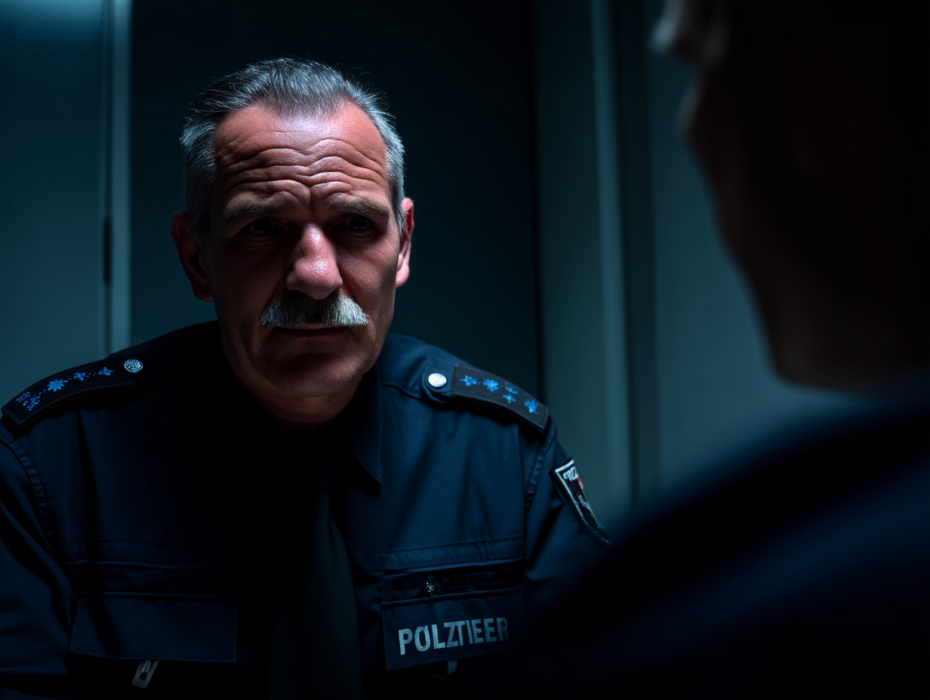
“How did you get the compass?” Vance asked. Liam swallowed. “I went to the scene after,” he said. “Not right away. A few hours later, but before the police came. We hear such news internally pretty quickly. I kept to the shadows. There were still marks on the barrier. Bits of glass.”
He continued, “I knew it was my car from what was left. I found the compass in the grass, near the ditch. I knew it wasn’t mine. I knew whose it was. I couldn’t leave it there. I was afraid, but I was also sorry for what I had gotten him into.”
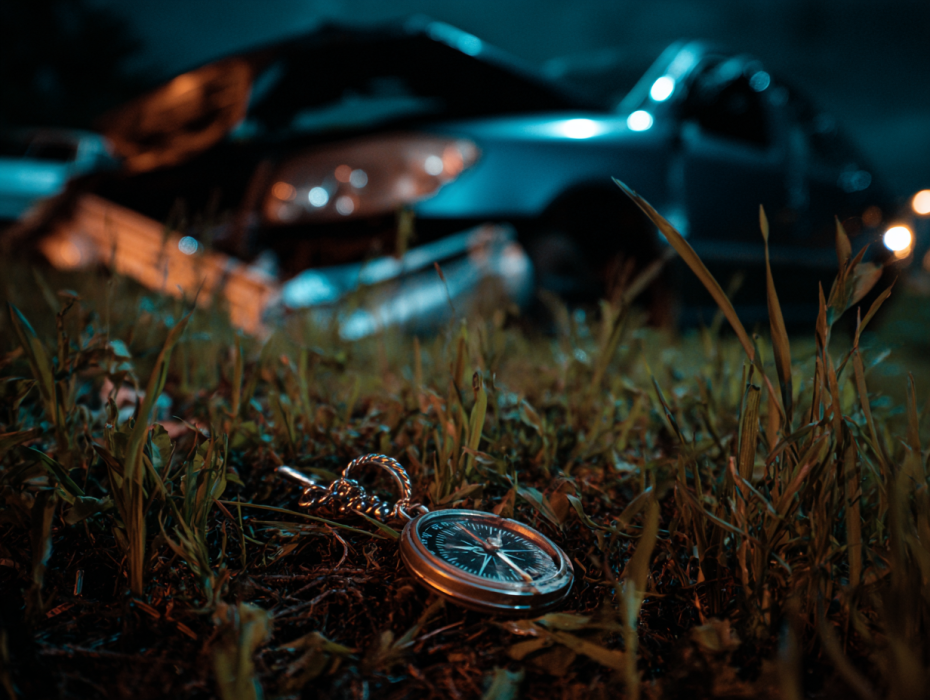
Vance pictured Liam standing where he had stood, looking at the wreck from a different angle. His anger didn’t disappear, but it became more complicated. “You took it,” he said. “You held onto it for two years.”
“Like I said, it ate me up, but I loved my own hide,” Liam said. “I promised myself, when the time was right, I’d return it to his family.” He looked at Vance. “But mostly, I kept it because I couldn’t face you. It was easier to hate myself than knock on your door.”
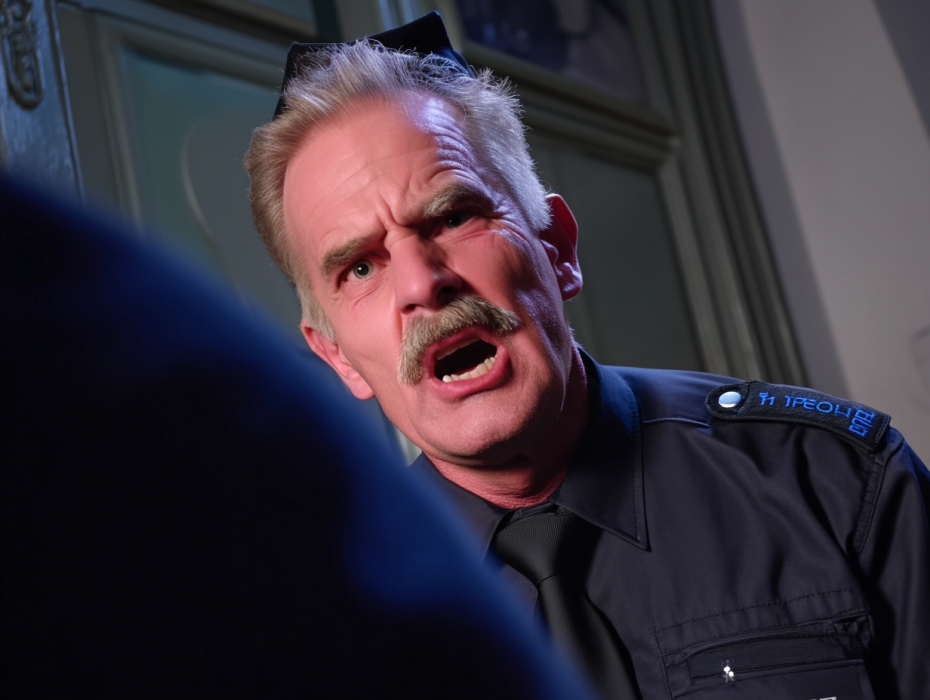
“You could have come forward,” Vance said firmly. Liam gave a tired, crooked smile. “To whom? The cops?” he asked. “Your people wrote it up as an accident before the wreck cooled. Someone in your department wanted it buried. What do you suppose they’d have done to me?”
Vance had suspected that part was true. He’d felt it in the way his questions had been redirected, in the neatness of the report. But even so, the certainty now filled him with shock. “So why admit all this now?” he asked. “Why, after all this time? What’s the point?”

Liam glanced at his hands. “Because I’m running out of places to hide,” he said. “The same people who watched that car haven’t forgotten me. I saw them near my shop this week. I figured if I am to disappear, you at least deserve the whole truth first.”
“You drove this route—my route,” Vance said slowly. “In a stolen car, so that…?” Liam nodded. “Part of me hoped you’d be the one who pulled me over,” he admitted. “Part of me hoped no one would. Either way, I had a fair idea my time was up.”
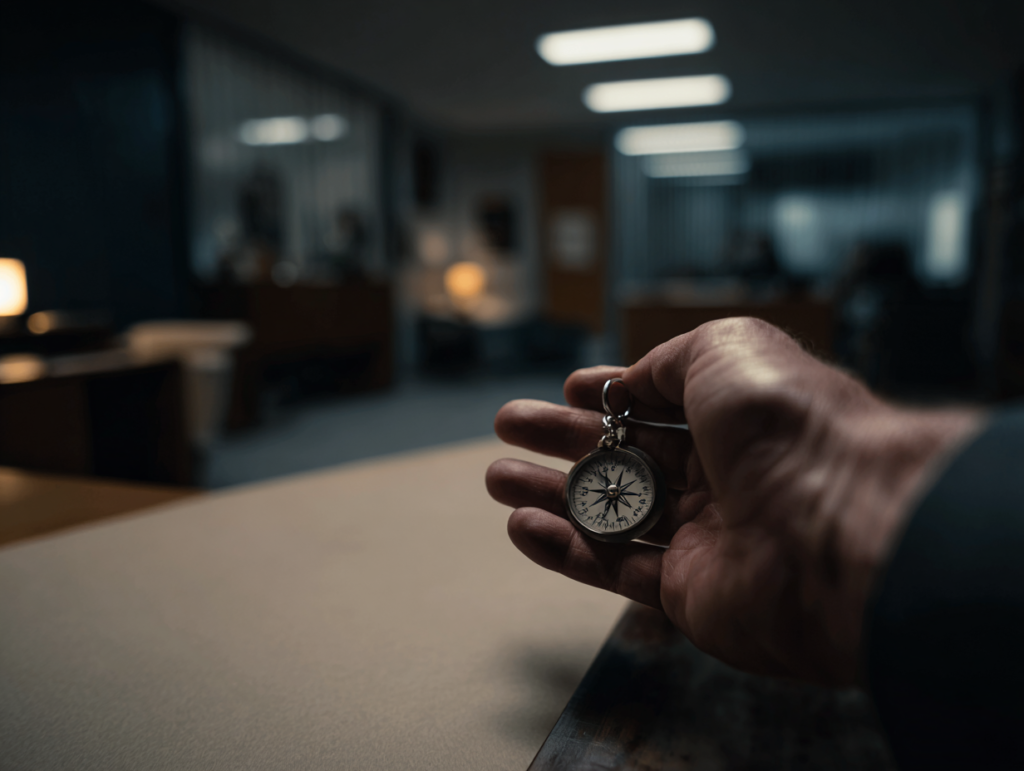
Vance looked at the compass in his hand. For years, he had blamed himself for not saving Adam from the path he’d chosen. Hearing this, he understood that Adam had taken risks Vance couldn’t control, guided by people his father didn’t know.
“Adam knew it wasn’t safe,” Vance said quietly. Liam nodded. “He did,” he said. “But he thought he could handle it. He thought it was just another small job. I let him believe that because it made me feel less alone. I probably told myself that it was okay too.”
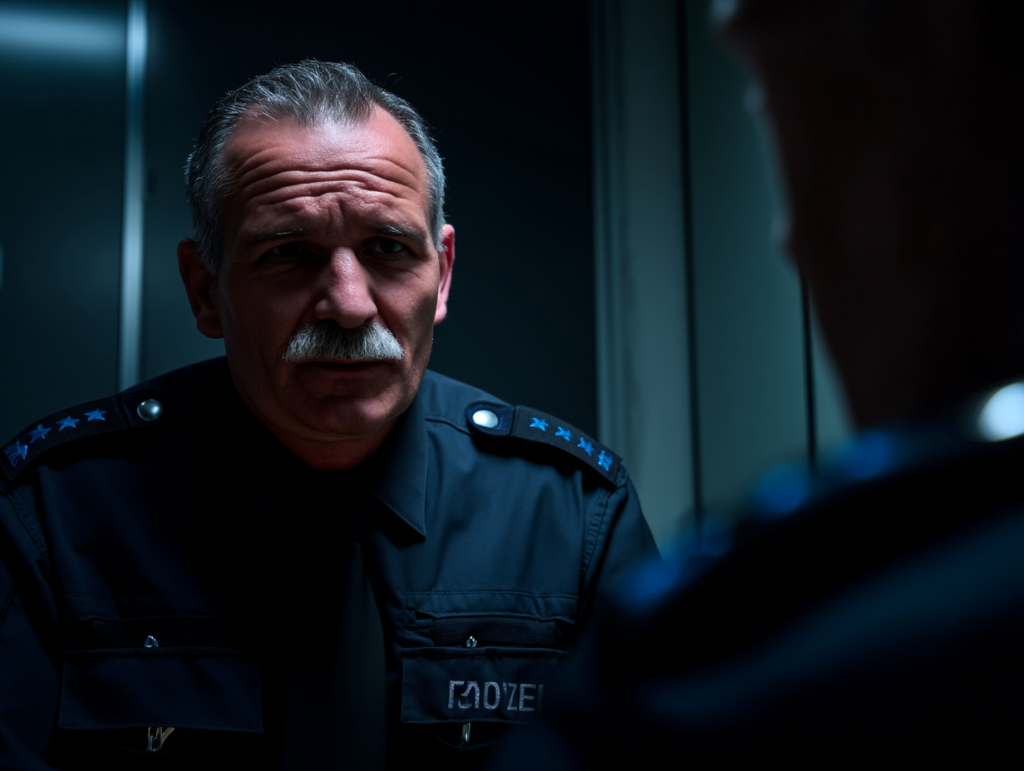
The confession sat between them, heavy and ugly. Rain softened outside the station. Vance felt something inside him bend, not break. The story he had told himself—that he had single-handedly ruined his son—shifted into something harder and truer.
“Well, you may be right about one thing,” Vance said. “This wasn’t clean. And someone helped bury it.” Liam watched him carefully and finally asked, “What are you going to do now?” he asked.
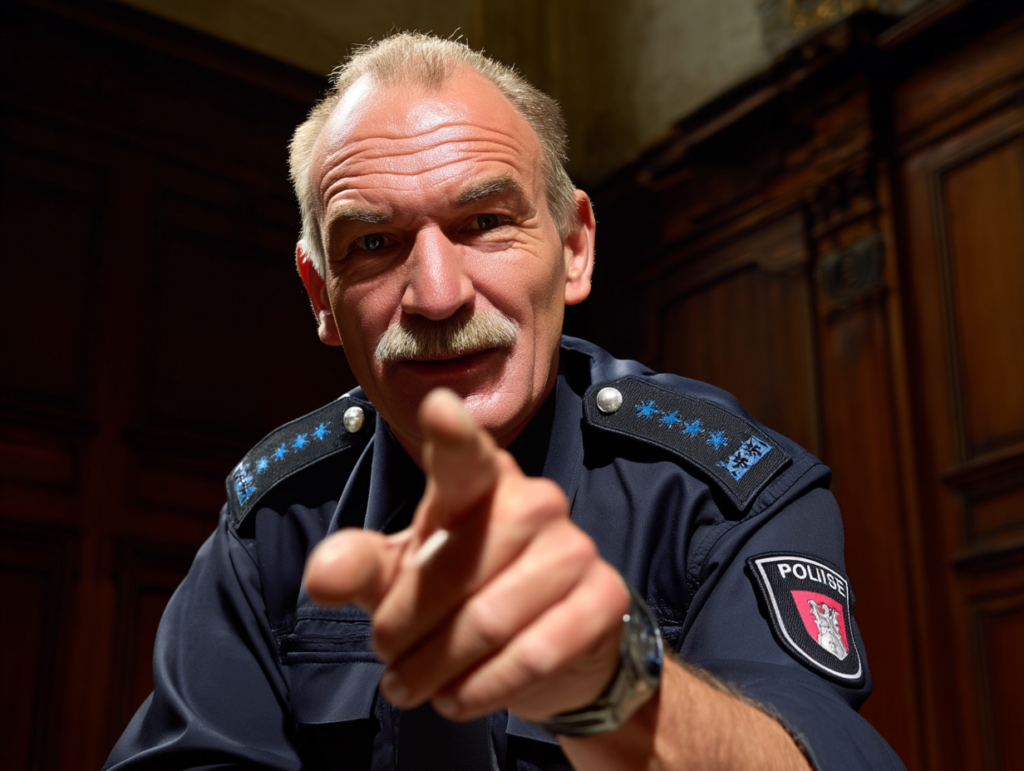
Vance looked ahead, then back at the compass he still clutched in his hand. “My job,” he said. “The part of it I can still live with.” He nodded at Liam and said, “You’re coming clean. We’re writing everything down. And you’re signing a statement.”
Fear flickered across Liam’s face. “If I do this officially, they’ll come for me before you can achieve anything,” he said. Vance shook his head. “They already are looking for you,” he replied. “The difference is, this time they won’t get to own the story.”

Vance made Liam repeat names, routes, and small thefts that grew larger. Liam described the men who fronted the money, the cars they used, and the way they talked about “making an example” when someone crossed them. He described the threats he’d ignored, the guilt that had dragged behind him since Adam’s death.
When Liam finished, Vance felt a familiar chill. The pattern fit too well. It was the same contractors he’d heard rumors about. Same streets. Same hands on both sides of the law. Adam had stepped into a web already spun long before he took the wheel.
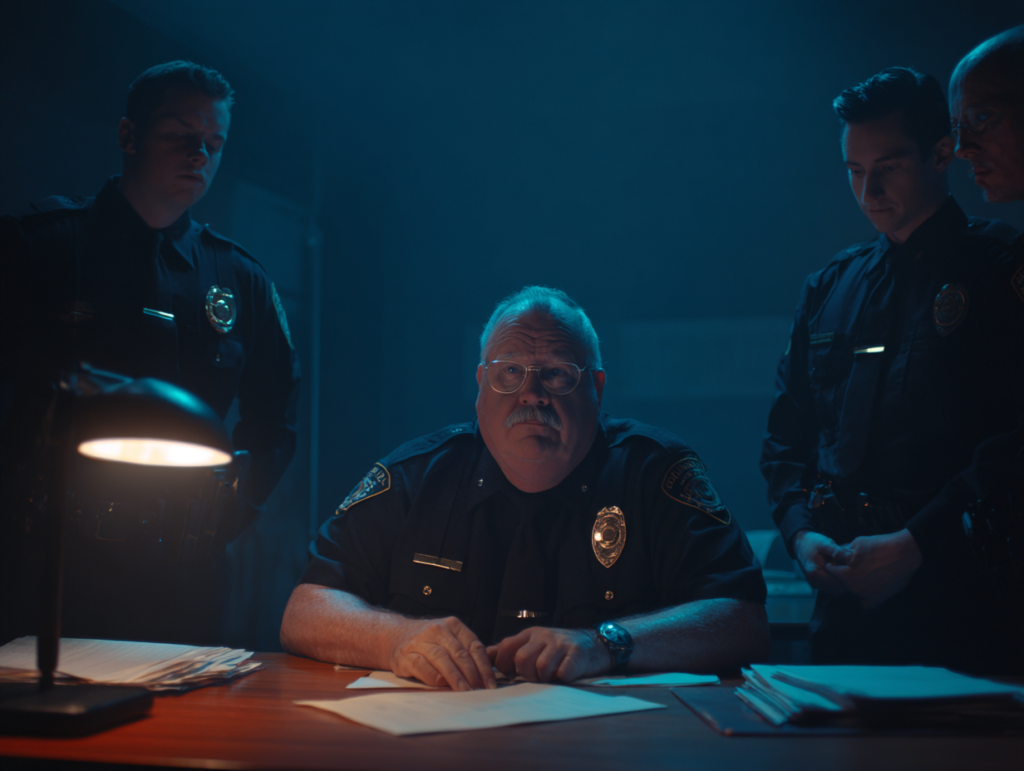
Internal Affairs listened to Liam’s recorded statement with flat faces. When it ended, no one spoke. “Old case. Old file,” one of them said. “A lot of people signed off on that.” The message was clear: reopening it meant accusing their own.
Vance refused to back down. He laid the compass on the table, then the photos, then Liam’s statement. “You missed this,” he said. “Or you ignored it. Either way, it’s on record now.” They didn’t like his tone, but they couldn’t ignore the pieces.
The first request to reopen Adam’s case came back stamped “insufficient basis.” Procedures, time limits, and technical phrases stacked up like a wall. Vance filed again, adding more detail. The second response was shorter: “No further action recommended.”
He started pulling old reports himself, using every favor he’d earned in twenty years. Tire analysis, scene photos, and officer logs from that night. Small glitches showed—wrong times, missing signatures, patrol cars marked present but never mentioned in the write-up.
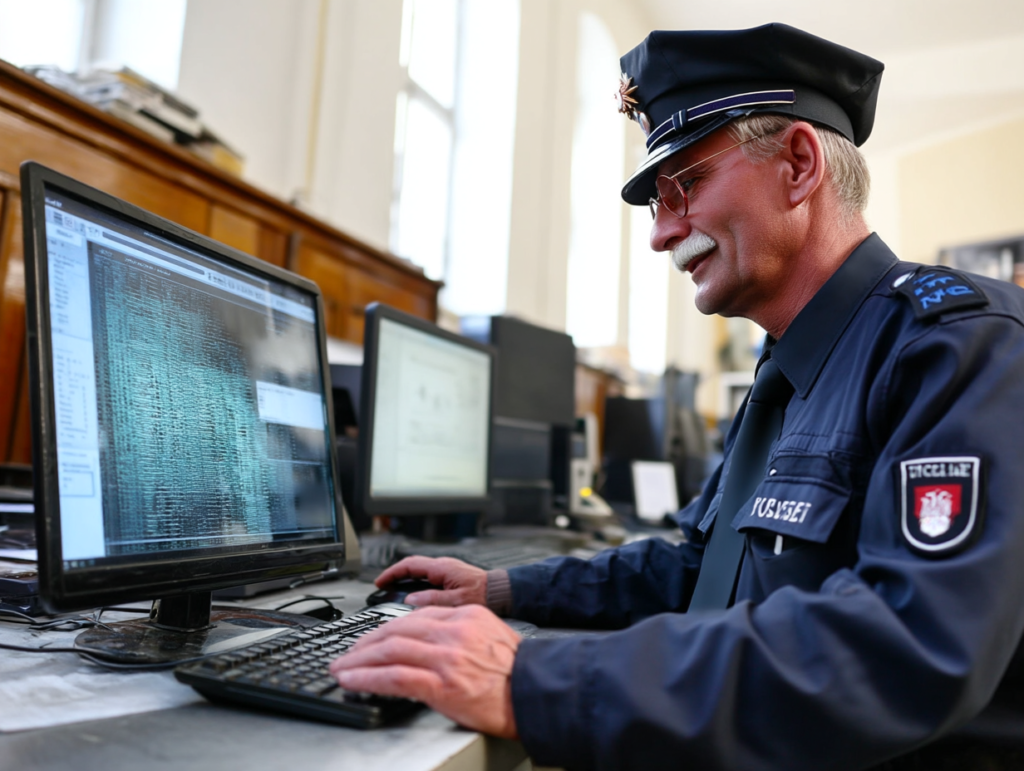
The more he found, the more doors closed. A captain reminded him that grief clouded judgment. A lieutenant suggested grief and trauma counseling. Someone left a printout of his original complaint on his desk with a sticky note: “Don’t dig him up. Let him rest.”
At home, the pressure followed him. He woke to anonymous calls that hung up when he answered. One night, his car alarm shrieked, and he found his windshield wipers bent backward, an ugly little message that said, clearly, “Stop digging for your own good.”
Instead, he dug deeper. He recorded every late-night call, logged every odd incident, and quietly copied every file related to Adam’s crash before it could vanish. He knew how evidence disappeared. He had watched it happen to other people.
Finally, he bypassed normal channels. He sent all the evidence—Liam’s statement, his own findings, and the suspicious discrepancies—to an outside oversight attorney who owed him a favor from an old case. “If they bury this,” he said, “they bury you with it.”
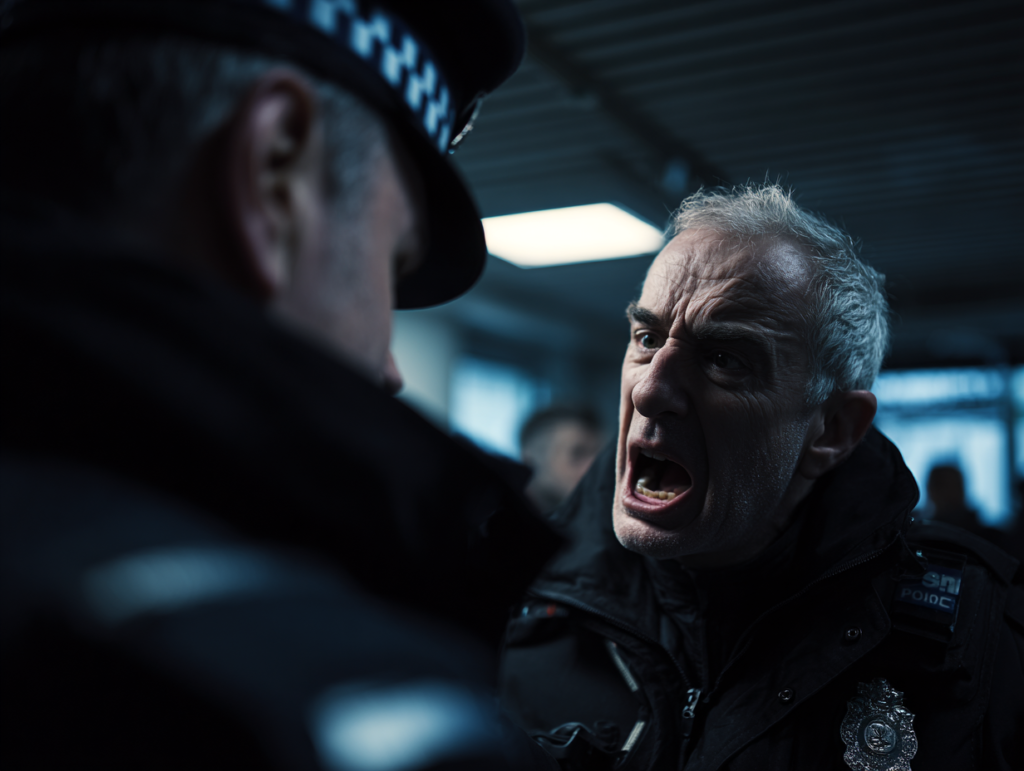
That move forced Internal Affairs to act. They called him back in, less guarded now, more tense. “You went outside,” one investigator said. “You left us no choice.” Vance almost laughed. “That’s right,” he replied. “No choice is how my son died.”
This time, the investigation didn’t stay quiet. Officers were reassigned. Old crash photos were sent to independent analysts. The vehicle logs from that night were pulled up and checked against GPS records. Gaps opened like cracks in a pavement after a hard winter.
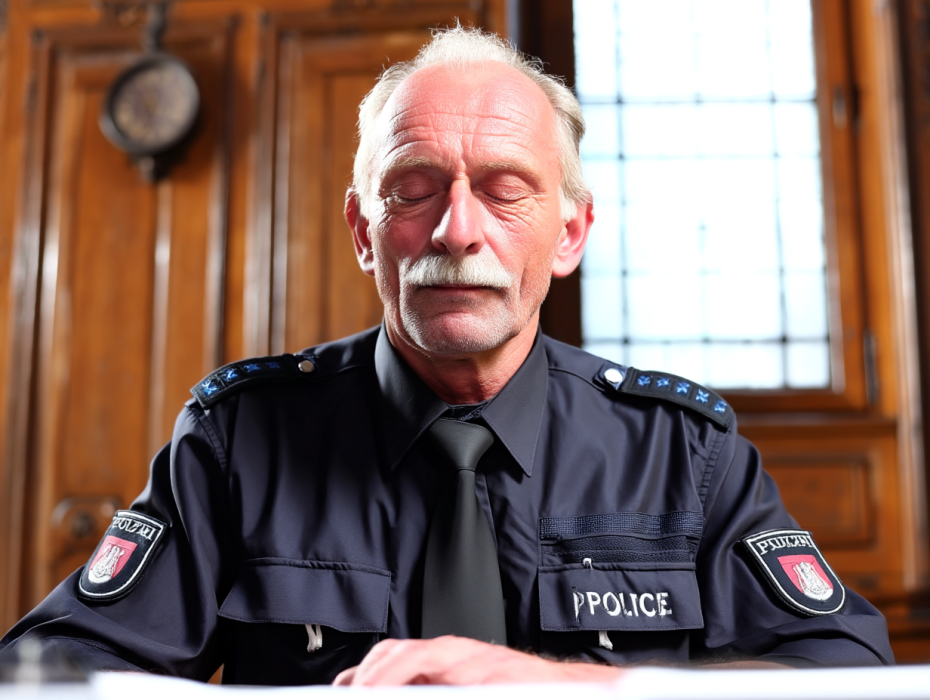
Vance watched from the edges. He wasn’t allowed to lead the inquiry, but he wasn’t shut out anymore. He answered questions without flinching, even when they involved people he once trusted. He named names when asked, and didn’t soften what he’d seen.
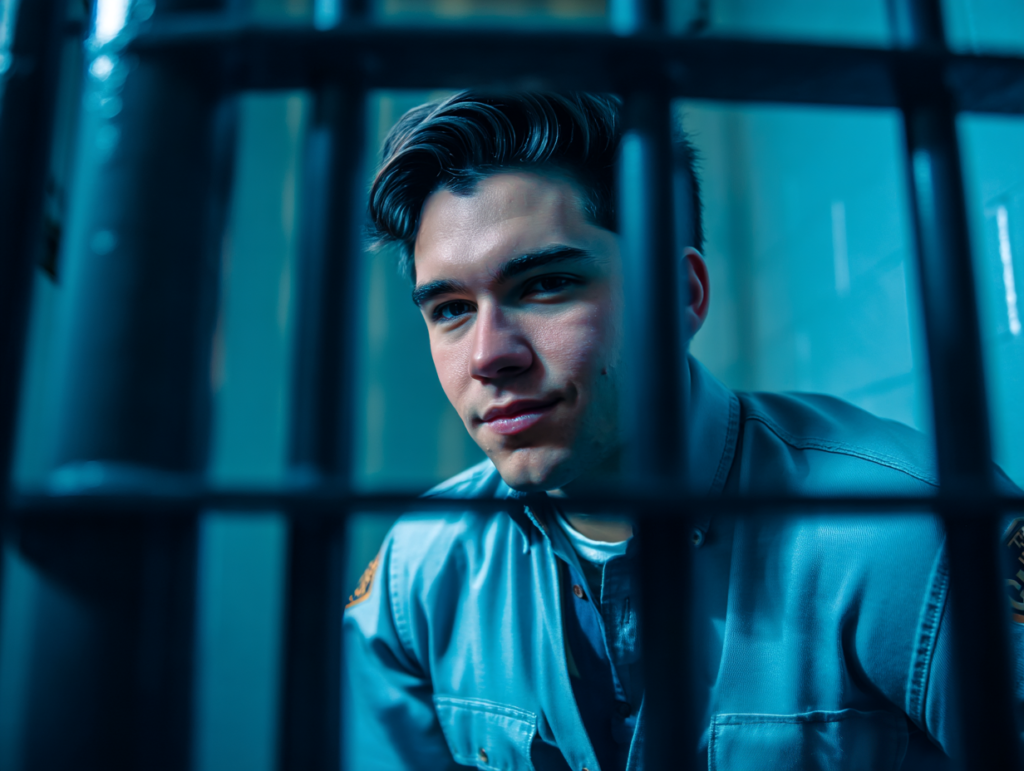
Liam, meanwhile, went into reluctant protective custody. He complained about the walls and the lack of windows, but he also slept through the night for the first time in months. He gave up addresses, meeting spots, and the nicknames of the men who ordered the hit.
There were many narrow escapes. One transport van carrying a minor witness blew a tire on a clear day. The driver swore he’d checked everything twice. An Internal Affairs agent “fell” down a stairwell. Vance had stopped believing in bad luck. He remained vigilant.
When charges finally came, they were layered and precise. Conspiracy. Tampering with evidence. Homicide. The crew who had treated Adam as the replaceable part of a job stared at printed indictments that were heavier than any cash they’d taken.
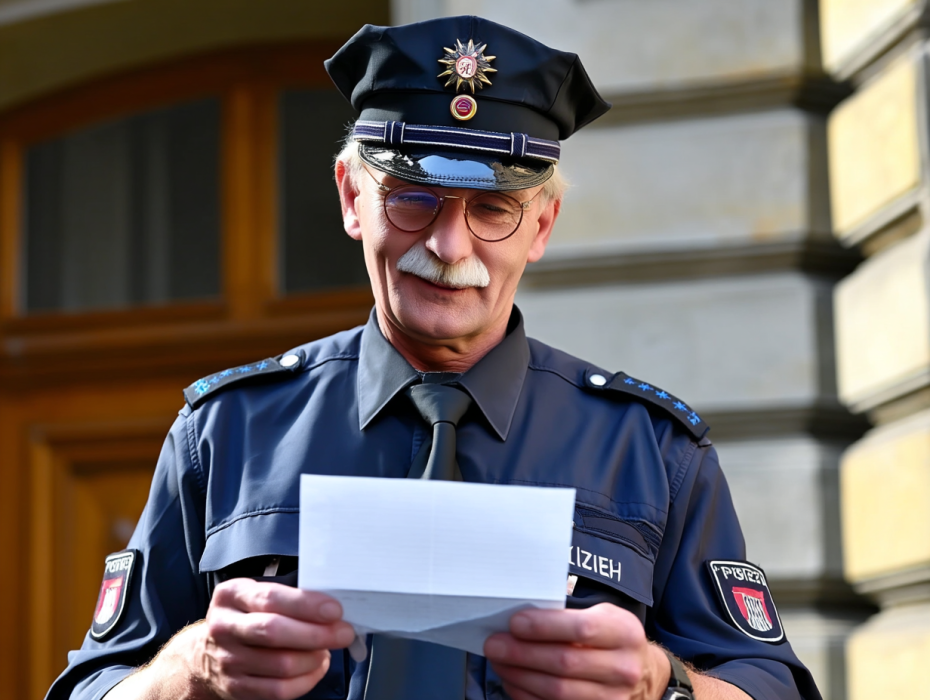
The hardest document for Vance to read was the new report on Adam’s death. It didn’t call him innocent. It named him as a driver for a criminal crew. It also called the crash what it was: a targeted hit on the wrong man, disguised as an accident.
Shame stung as he read. But underneath it ran a steady current of something he had not felt in two years—relief. The truth was ugly, but also real. Adam had chosen badly. He had also been lied to and used as a shield by someone who was scared.
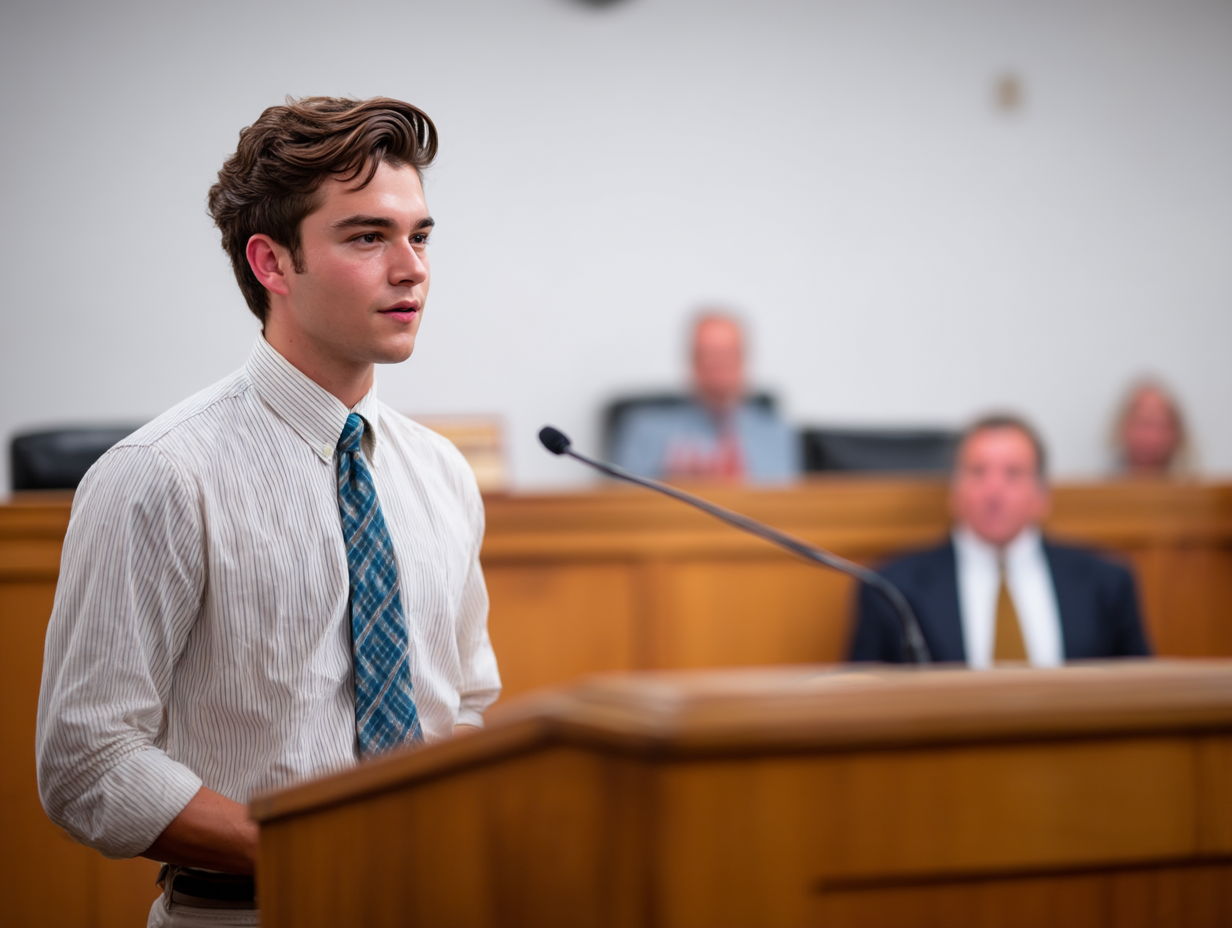
Liam testified once, under heavy guard, in a courtroom that smelled of old paper and nerves. As an informant, he cut a deal for himself—a reduced sentence in return for everything he knew. His hands shook, but he refused a new identity. “I hid enough from them,” he said. “I’m done hiding for myself.”
After serving his term, he left town without telling Vance where he was going. A few days later, an envelope arrived with no return address. Inside, a short note: I’m sorry. For him. For you. Sorry doesn’t fix it, but at least now you know who aimed the gun and who didn’t.
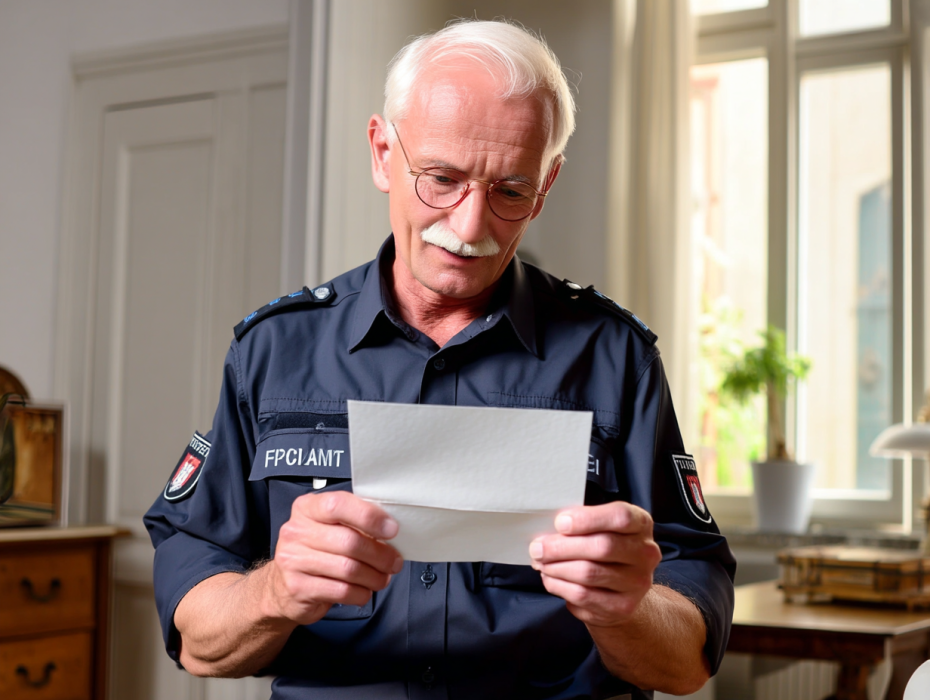
Vance read it twice. The blame he’d carried—believing he alone had driven Adam toward that life—shifted. He still wished he had been a better father. But he no longer believed he had written every line of his son’s story or pulled the trigger on its ending.
On a quiet evening months later, Vance drove out to the stretch of road where the crash had happened. The barrier had long been replaced. The scorch marks were gone. To anyone else, it was just another bend where drivers eased off the gas without knowing why.
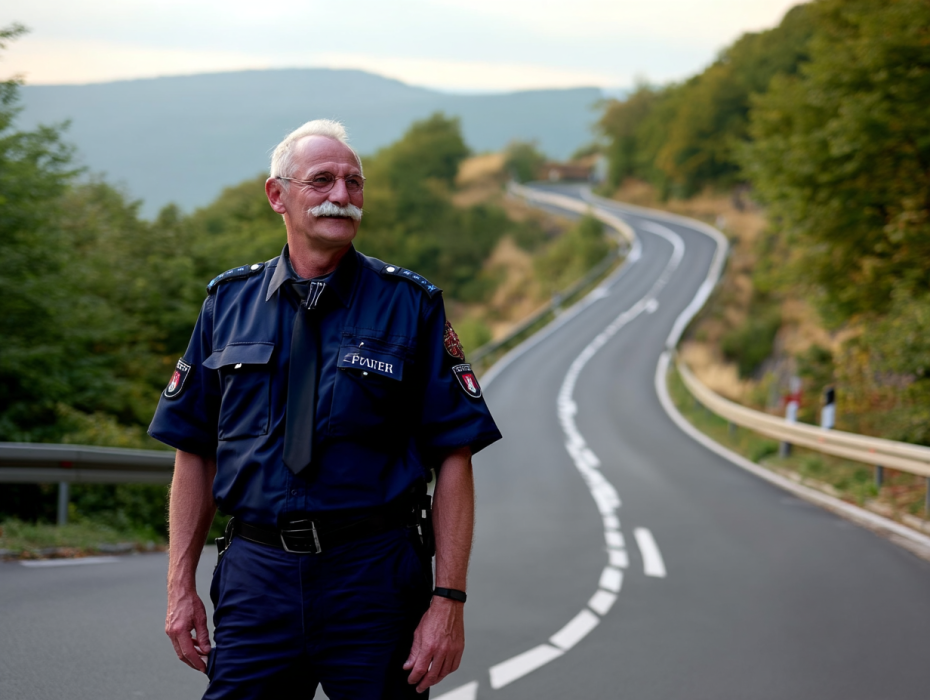
He stepped out with the compass in his hand. The sky held its rain for once. Headlights slid by at regular intervals, each car carrying people who would never know this was where one life ended, and another had been stuck in place. Vance stood there a long time.
He replayed the hallway argument and the assumptions. He understood, finally, that loving Adam meant loving all of him: the good, the stubborn, the foolish, and the kind. Adam’s choices had been his own. Vance’s failures as a father mattered, but they weren’t the only reason the story ended at this curve.

He placed the compass on the barrier, exactly where the metal had once buckled. “You were wrong about one thing,” he said quietly. “You weren’t just a driver. Your choices mattered. So do mine. I’m still here. I’ll do better with what’s left.” Then he stepped back and let the wind spin its needle.