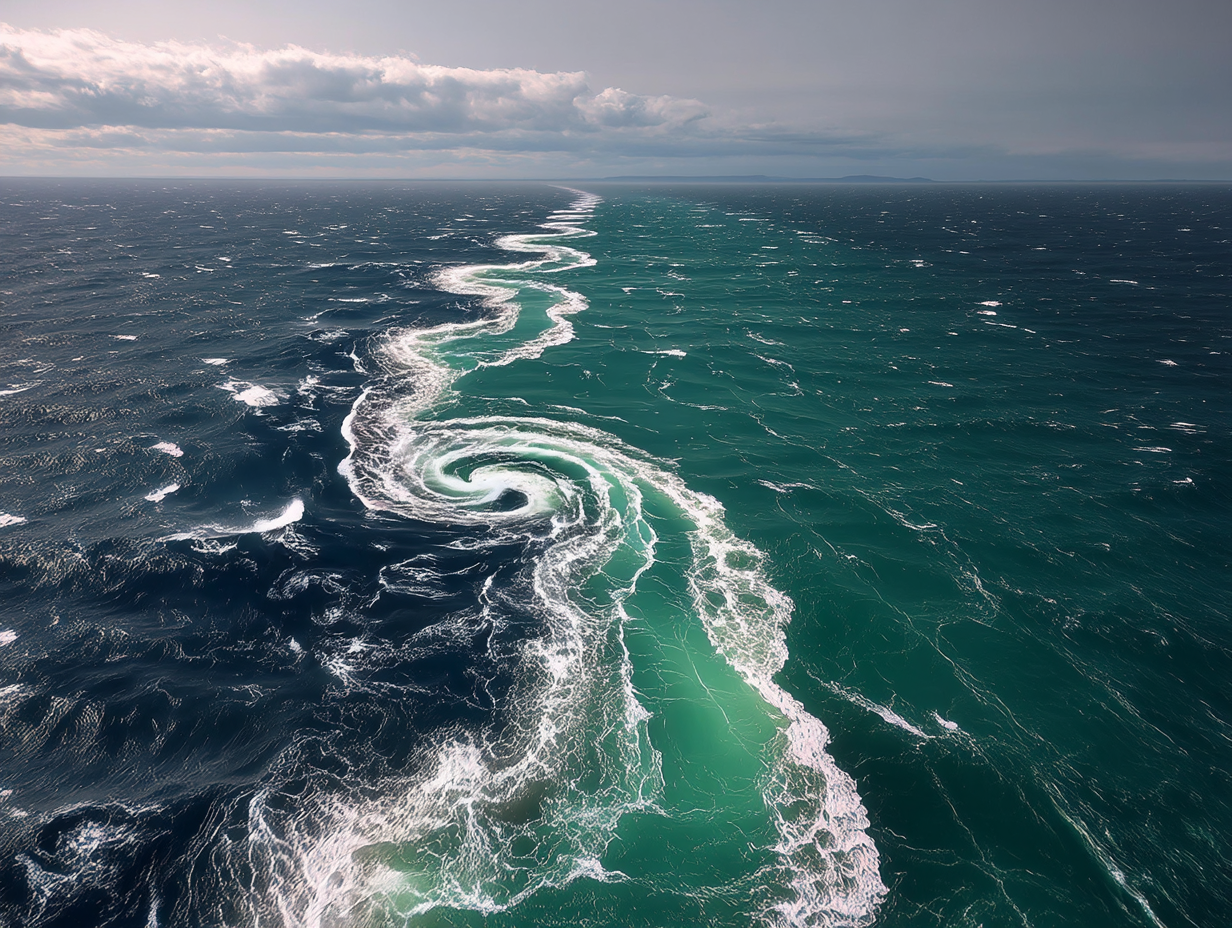
Nora Hale stood on the cliff path above Blackwater Cove, in the cold draft chafing her skin, staring at a strip of white moving over the gray sea. It did not spread like foam or break like waves. It seemed to glide, deliberate and silent, toward the reef.
The words whispered themselves in her mind, “The Serpent Line.” They slid straight under Nora’s skin. The moment she remembered those words, the cove below stopped looking like water and began looking like a distant memory, and it frightened her.
Then the shaky video lurched closer. A small rowing boat drifted near the spinning patch at the end of the pale trail, and something dark and narrow rose from the center before sinking again. Nora went cold…What was it that she just saw?
Three days earlier, Nora had been in her city flat, halfway through answering work emails, when her aunt Maggie called just after dawn. Maggie rarely phoned before breakfast. When Nora heard the strain in her voice, she knew at once that something from home had gone wrong again.

At first, she thought there had been an accident in the village, some ordinary kind of bad news involving weather, age, or drink. But Maggie said the sea had been seen “acting strange” near the reef again, and that old talk had started before the kettles even boiled.
Nora nearly laughed then, though the sound came out brittle. Blackwater Cove had always dressed fear in old stories and superstition. If fog lingered too long, it meant something. If gulls screamed at night, it meant something else. The village had never been able to let the sea be itself.

But Maggie’s next words stopped her. A local boy had filmed the water at dawn, she said, and the clip had spread so quickly that by noon people were speaking of Thomas Hale again—Nora’s father, a fisherman, who had perished there eighteen years ago.
He had vanished when Nora was thirteen, out beyond the reef in weather no worse than a hundred other mornings. His body hadn’t been found, and no broken hull had washed in; no final proof had ever surfaced. The gap left behind had been wide enough for superstition and loose talk to do their work.

The story the village chose was the one Nora hated most. People said the Serpent Line sometimes showed itself before the sea took what it wanted. They said Thomas must have seen it that morning. Within months, the tale had grown teeth, and worse, it had become a way for people to start making money.
A husband-and-wife pair from the village, Martin and Celia Voss, leaned into the myth first. They printed postcards of the reef, sold Serpent Line mugs and keyrings, and ran early-morning “legend walks” for summer visitors who wanted a brush with the village folklore.

Others followed. A pub on the bay sold Serpent Line ale one season. A gift stall near the quay stocked painted driftwood charms and little booklets about “the curse of Blackwater Cove.” Once, to her fury, Nora even saw a flyer offering boat trips along “Thomas Hale’s final route.”
She had never forgiven the village for making money out of her family’s grief. Her father had not become a memory there. He had become a story, then a symbol, then a way to coax coins out of tourists. By the time Nora left for studies and then work, she distrusted not only the legend but everyone who kept spouting it.

That was one reason she stayed away so long. Every time she came home, she found some fresh little trace of the myth still being fed: a painted sign, a joke in bad taste, or a visitor asking where the fisherman had vanished. Distance had become easier than rage.
Aunt Maggie, her dad’s sister, met her at the door with flour on her sleeves, and worry pressed into every line of her face. She hugged Nora too tightly for comfort, then immediately asked whether she had eaten. That was how Maggie handled all disturbing news. She was one of those who believed that food was a cure for everything.

Later, in the kitchen, Maggie fetched the old biscuit tin from beneath the stairs. Inside it, she stored away newspaper clippings, folded notices, and a photograph of Thomas grinning beside his boat. Nora had not asked to see any of it, but Maggie must have sensed Nora’s need to revisit their shared memories of her father.
One clipping called Thomas’s disappearance a boating accident in uncertain waters. The phrase made Nora’s jaw tighten. She remembered what the paper had omitted: the murmurs on the quay, the neighbors lowering their voices, and the certainty that he had gone after something pale seen moving offshore before sunrise.

Nora asked, “Did anyone even investigate it properly?” but Maggie only sighed and said, “Stories in small villages gather and borrow, until people are too scared to ask further.” Still, after a moment, she gave Nora the name of one person who might know more—Cal Brewer, who was now the harbor master.
Cal had once been her father’s closest friend, the man who helped carry wet ropes, mend engines, and sit through the awful quiet after storms, wondering if all boats and seamen would make it back alive. Back then, he had laughed easily. Nora remembered him. She also remembered how little he spoke in the weeks after Thomas vanished.

The next morning, she found him near the slipway, checking mooring lines with hands gone broad and knotted from years of salt and cold. He looked up when she called his name, and whatever welcome might have been there faded the instant she mentioned the new video doing the rounds.
Nora held out her phone, but Cal barely glanced at the moving white trail before looking back at the ropes. He told her to leave old things alone. His tone was flat and almost bored, yet something in it rang false, like a door that shut too quickly.

She asked whether he believed in the Serpent Line. Cal’s jaw tightened. He said belief had nothing to do with it, which was not an answer at all. Then he added, “Some things are dangerous whether people understand them or not.” That unsettled her more.
Nora pressed him further, but Cal turned away and asked after Maggie instead, as if a change of subject might sweep away the conversation. It did not. Nora walked off angrily. Yet beneath the anger sat a colder feeling. Cal had not looked annoyed. Had he looked—afraid?

That afternoon, Nora wandered through the village, hoping loose talk might reveal something more concrete. Instead, she found the same old split she remembered: the truly frightened, and the ones who enjoyed the fear too much. In Blackwater Cove, dread and commerce joined hands against common sense and truth.
The old souvenir stall by the quay was gone now, but its faded signboard still leaned inside a shed: Serpent Line Keepsakes. Even after all these years, the sight of it filled Nora with disgust and anger. It reminded her how eagerly some people had dressed grief up as folklore, at the cost of other people’s misery.

That history was why she nearly dismissed Eli Mercer the moment he came to Maggie’s door with his drone footage. For one hard second, she thought this was just another version of the same ugliness—another trick, another thrill, another excuse to wake up the village’s old appetite for the gruesome.
Eli set the phone on the table and replayed the dawn footage in silence. Nora watched more carefully this time. The white shape did not fan outward like ordinary foam. It held a narrow line, wavering yet steady, as though it were following something laid beneath the surface.

Near the end of the clip, that pale line bent toward the old reef and narrowed further before the water began turning in a slow, dark circle. The image trembled there, then caught the black shape lifting briefly through the center, thin as a post or an arm.
Eli admitted he had not gone back to capture more videos. His mother had forbidden it. Too many people in the village were talking, he said, and his younger sister started crying whenever anyone mentioned the reef. Nora almost told him they were all being ridiculous, but stopped.

Because if she were honest, the video unsettled her precisely because it did not look staged. There was nothing theatrical about it. No dramatic music, no clever angles, no village storyteller trying to turn fear into profit. It looked awkward, accidental, and far too close to her father’s notes.
Nora convinced Eli to accompany her to the place where he caught his footage. The next morning, they met on the cliff path above the cove, where the wind bit through her coat and the sea below lay dark as slate. They waited with the drone ready, saying little, while most of the village still slept behind shuttered windows.
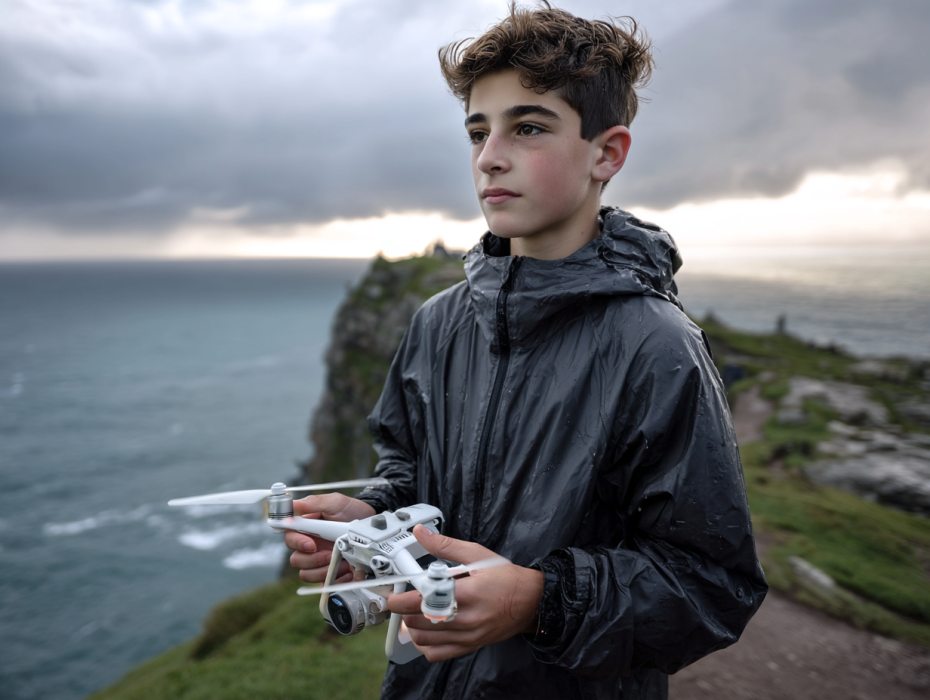
The first change came so subtly that Nora almost missed it. A faint pale line appeared far beyond the reef, not bright but milky, but like something brushing the surface from beneath. Eli said nothing. He only nudged the drone forward while Nora felt the hair rise on her arms.
The line lengthened as they watched. It did not break apart the way foam usually did, nor did it vanish under the morning chop. Instead, it curved with strange patience, drawing a wavering path across the bay as though some unseen body were moving just under the water.
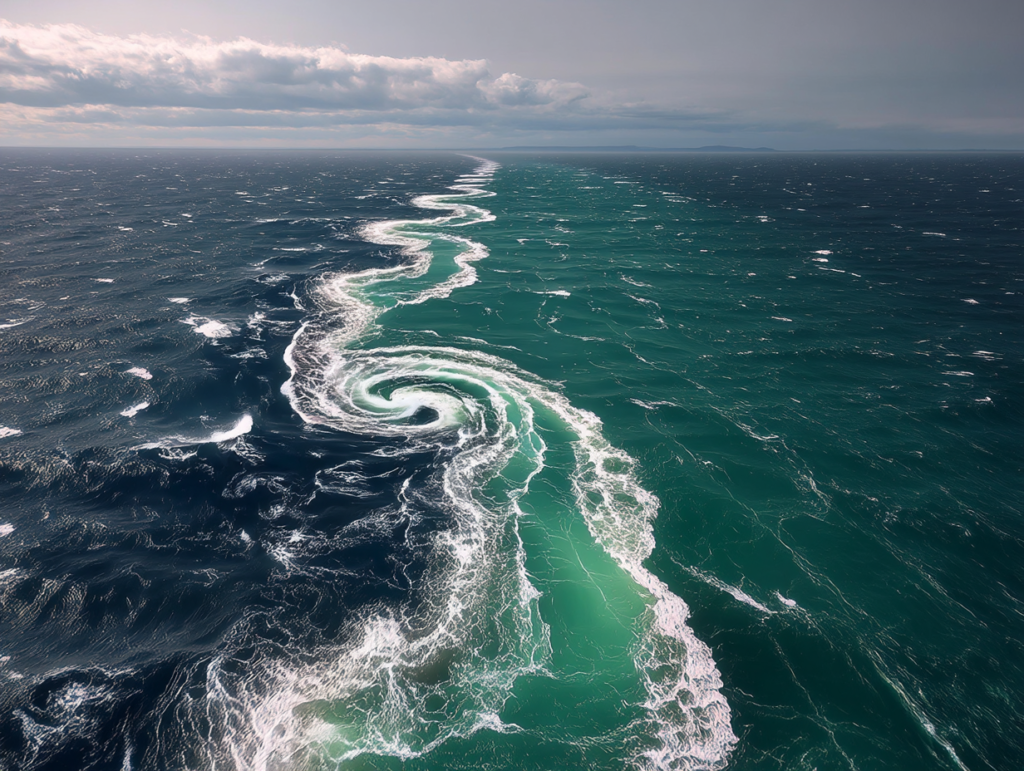
Eli lowered the drone slightly, and the live image sharpened. The white trace slid onward until it reached the darker water near the reef, where the sea began to turn in a slow circle. Nora’s throat tightened. She had seen the earlier video, but in person, it felt even more eerie.
A sudden shout rose from the harbor below. A hired rowing skiff, cut loose from its mooring or badly tied, had drifted farther out than it should have. It rocked in the swell, empty, but moving toward the same dark patch where the pale line seemed to end.

People spilled onto the quay and cliff path almost at once, still pulling on jackets, waving uselessly toward the water. Someone yelled for the lifeboat. Someone else said it had chosen a target. Nora hated how quickly panic made the village slip back into the language of superstition.
Then the sea changed shape again. At the very center of the swirling vortex, something dark rose sharply through the surface, thin and upright, before sinking just as quickly. It was there only a heartbeat, but long enough for the crowd of people gathered to recoil and gasp as one.
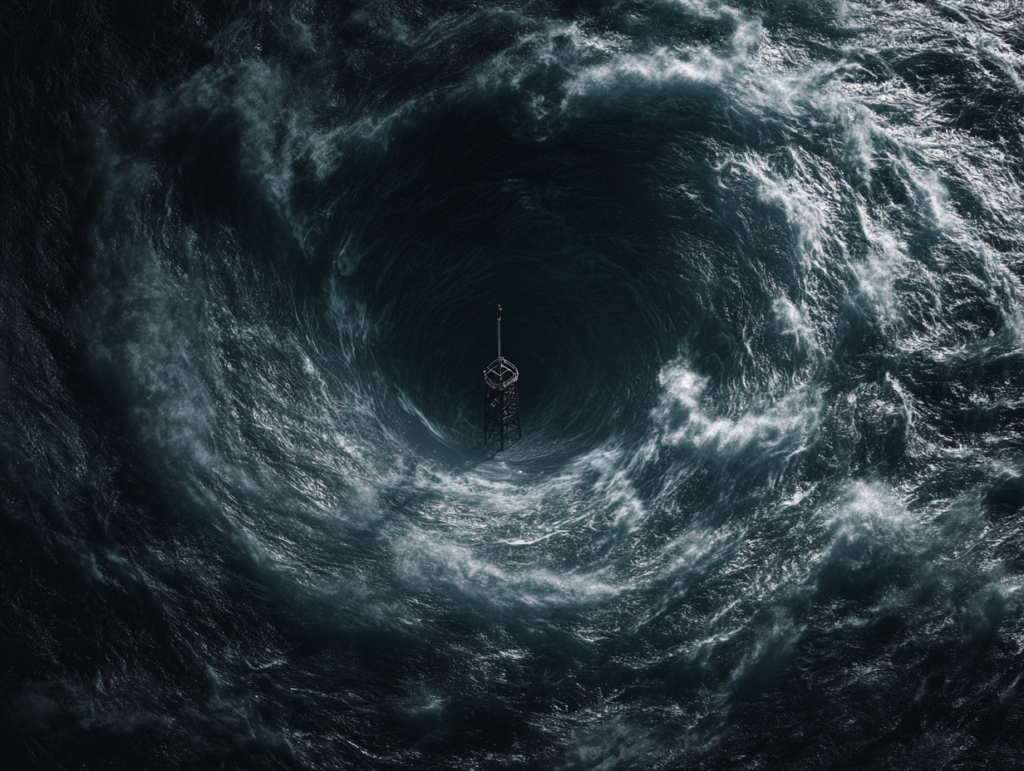
Eli swore under his breath and nearly lost control of the drone. Nora grabbed his elbow to steady him, though her own hands had gone cold. The thing had not moved like driftwood. It had appeared fixed, as though arising from below, waiting for the turning water to reveal it.
By then, someone had launched a lifeboat. Its engine cut a harsh line through the morning stillness as it sped toward the drifting skiff. Even from the cliffs, Nora could see the crew keeping well clear of the pale trail, circling wide as if no one trusted the water around it.
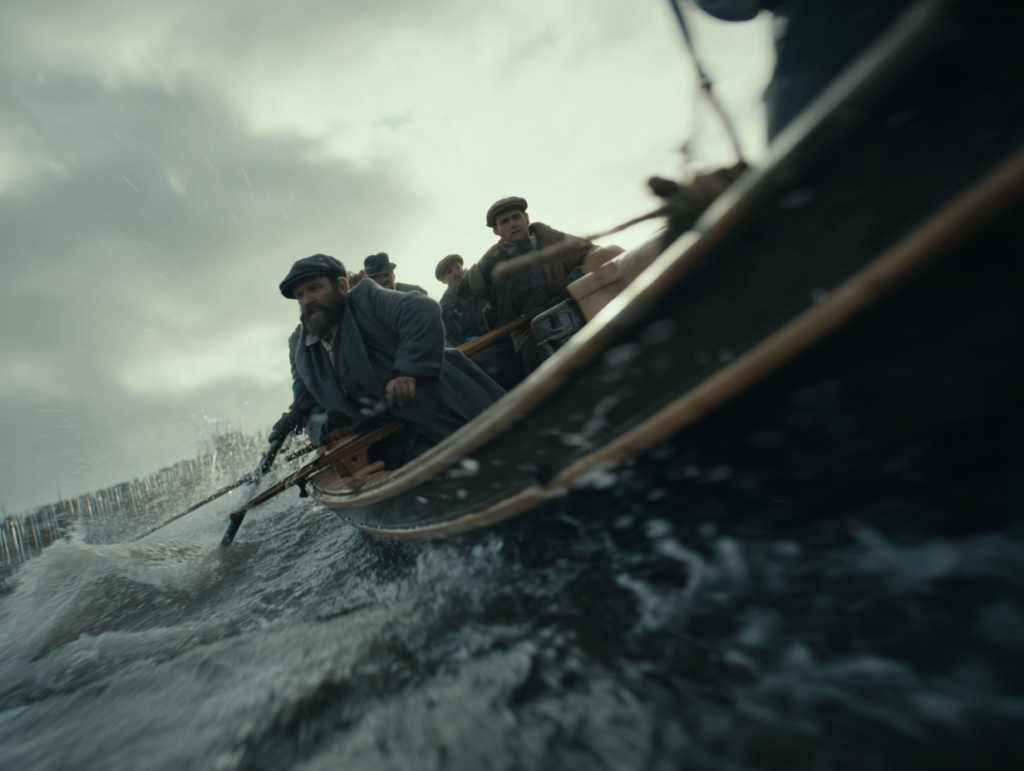
The skiff was hooked and dragged back before it crossed the darkest part of the spinning patch. The rescue took less than three minutes. Yet when it was over, the whole cove seemed altered. The white line thinned, the circle weakened, and the sea became ordinary again quickly.
That sudden return to normal disturbed Nora almost more than the sight itself. If the water had stayed violent, she could have called it weather. But it changed like a curtain falling, as though something had used the bay for a moment and then retreated before daylight strengthened.
By breakfast time, the new footage had moved through every house in Blackwater Cove. Some villagers looked genuinely afraid. Others wore the bright, hungry expression Nora remembered from years ago, the look that always appeared when the Serpent Line started becoming useful to some people again.
Nora saw the comments below the video, which someone had uploaded on YouTube. Someone wondered whether visitors might come if word spread online. Someone else joked about bringing back the dawn walks. The carelessness of it turned her stomach. It only deepened her need to prove the whole thing was either fake or ordinary.

Nora realized her need to keep digging into the Serpent Line. She scoffed at any explanations that relied on superstition or horror, of course. But she wanted to kill the myths properly this time. Her goal was to strip it of mystery, expose the trick or mistake beneath it, and deny the village one more chance to profit from her father’s demise.
Alongside Eli, she watched the video on a loop. Eli noticed something. Along parts of the pale line, the water seemed to fizz or break in tiny silver bursts. He said, “It looks as if something is breathing under the surface.” Maggie snapped at him, “Don’t say that aloud. Stop repeating foolishness indoors.”

Maggie admitted the village had not been this stirred up since the years after Thomas vanished, when cars from outside sometimes lined the cliff road at dawn, and strangers bought tea and trinkets while waiting to see something that would make a good story later.
Nora asked again whether anyone had truly seen the Serpent Line before her father disappeared, or whether the story had only swelled afterward because grief and greed made such a convenient pair. Maggie did not answer directly, which gave Nora her answer.

She took her father’s notebook back to her old room and read it again from start to finish. Most pages meant little: weather notes, tide marks, sketches of the shoreline. But ever so often, a line would appear that made her stop, like a voice speaking through the fog.
One page simply read, “It showed itself again before sunrise—same path as before.” Another said, “Not what they think. Still dangerous.” There were no explanations, only fragments. Nora traced his handwriting with one finger and felt a chill pass through her that had nothing to do with the sea wind.

The next morning, she visited Mrs. Wren, the oldest woman in the village, who kept a coal fire burning even in mild weather and seemed to remember every birth, marriage, and drowning in Blackwater Cove. If anyone knew where the story began, it would be her.
Mrs. Wren listened without interrupting, her pale eyes fixed on Nora’s face rather than the notebook in her lap. When Nora asked about the Serpent Line, the old woman said she had heard of it as a girl, whispered after certain mornings when the reef looked ominous.

But when Nora asked who first named it, Mrs. Wren only smiled sadly and said, “Names came later. First came fear. Fear makes people build stories around it. I honestly don’t know when we started referring to it as the Serpent Line.”
That answer left Nora strangely relieved, because it sounded human rather than mystical. Yet Mrs. Wren added one more detail before she let her go. “Long ago,” she said, “men used to go out to the reef for work; no child was allowed to ask about it.”

Nora turned back. Mrs. Wren would say no more except that there had once been an iron structure out there, and noise, and men convinced that the sea could be made useful. The old woman crossed herself after saying it, which only made the memory feel heavier.
That afternoon, Nora walked the shore below the cliffs while the tide pulled away from the rocks. She searched without admitting to herself what she hoped to find. The beach gave her only weed, broken shells, and gull feathers until near the reef she spotted a streak of rust.

It clung to a jagged stone in a pool no larger than a basin. When she reached in, her fingers closed around a thick old bolt, orange with age but clearly shaped by human tools. She turned it over in her palm and felt her pulse begin to climb.
It might have come from anywhere, she told herself. A boat fitting. A crate. A storm-torn railing. Yet the farther she walked, the more scraps of old metal she noticed caught between stones, hidden so well that only someone looking closely would have seen them at all.

That evening, she showed the bolt to Cal at the harbor office. He looked at it for only a second before telling her, “The sea throws out all sorts of rubbish.” But his voice had gone rough, and when she mentioned Mrs. Wren’s story, color drained from his face. It was clear she would get nothing more out of him.
Nora asked him plainly whether there had once been some structure on the reef. Cal stared past her through the office window toward the water, jaw working as if he were chewing on words he could not swallow. At last, he said, “Some things are better left buried.”

Nora stepped closer and asked whether Thomas had known about those buried things. Cal’s eyes flashed then, not with anger but with misery. He told her, “Stop digging into the dead unless you want the cove to take something from you, too.” She left feeling shaken, but vowed not to be silenced.
Near midnight, Eli appeared again, breathless and pale, carrying his drone case like contraband. He had gone through older footage stored on his laptop, he said, and found another strange morning from months earlier. The pale line was fainter there, but it was unmistakably the same path.

Together they watched the older clip in the blue light of Maggie’s kitchen. Halfway along the line, the water seemed to bubble in tiny patches before smoothing over again. Nora felt a twist of doubt then. Could there be some truth to stories of an underground creature?
Maggie refused to watch the clip twice. She said the village had fed this thing enough already, and some people would only use fresh fear to start the old nonsense again. Then she covered the phone with a tea towel, as if hiding the image might stop it spreading further.

Sleep eluded Nora. She sat with Thomas’s notebook at the kitchen table, turning pages until one rough sketch caught her eye: the reef drawn at low tide, a cross marked on its far side, and beside it the words, “only when the water leaves enough stone bare.”
At dawn, she took the notebook to Eli. He recognized the shape of the reef at once and agreed to go, though he tried to sound braver than he felt. Neither of them told Maggie where they were headed. It was easier that way for everyone.
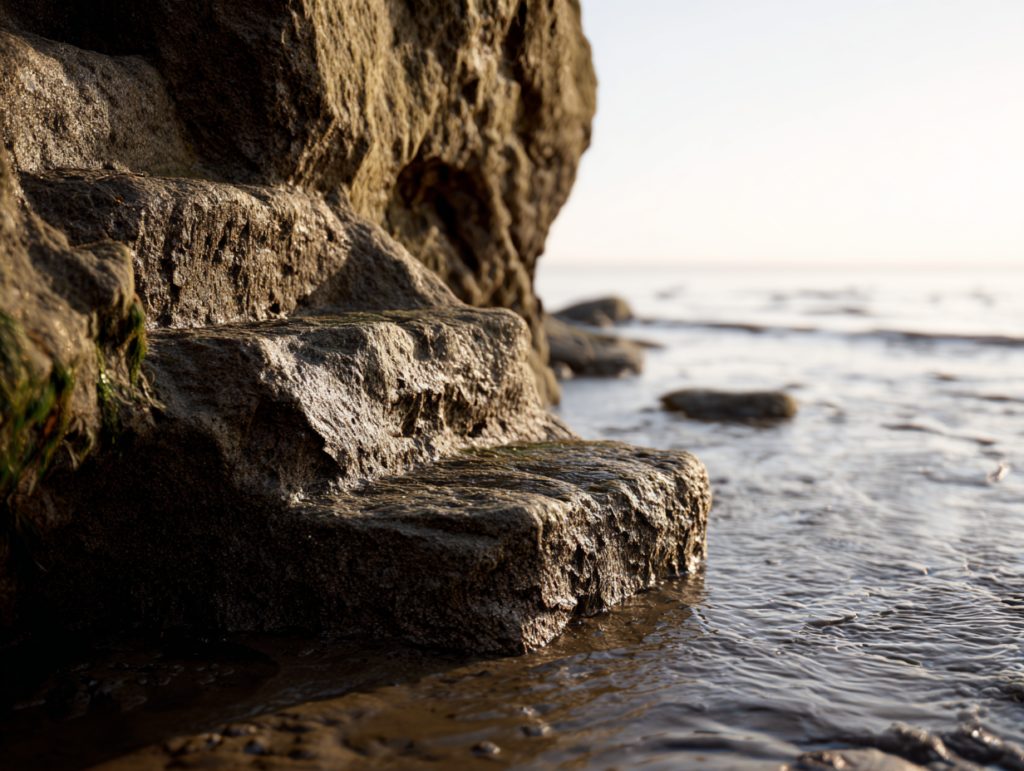
The tide that afternoon fell lower than it had in days, uncovering slick rock and narrow ridges usually hidden under moving gray water. Nora and Eli crossed carefully, boots slipping on weed, until they reached the far side, where the village cliffs blocked most sound from shore.
There, half-hidden under limp weed and old shell crust, stood a flat slab of concrete wedged between natural stone. It did not belong there. Four rusted bolts rose from it in a square, and the rock around it looked cut, not shaped by tide or time.
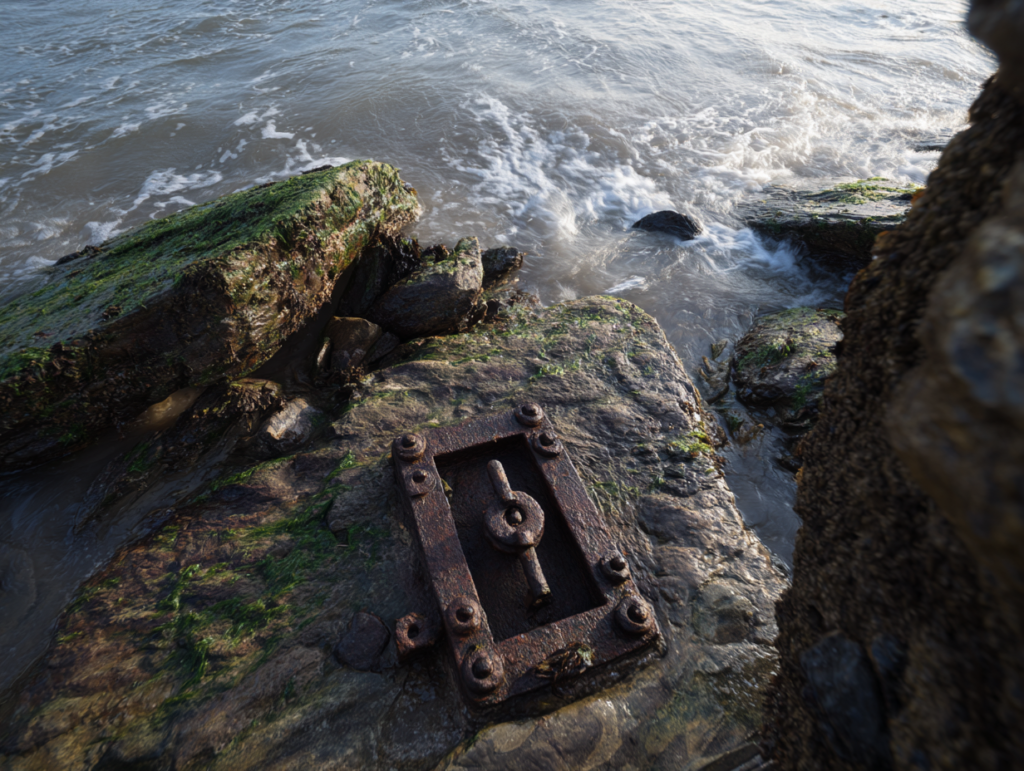
A few yards farther on, Eli called her name in a strangled whisper. Behind a low outcrop, tucked into shadow, lay the top of an iron hatch almost swallowed by barnacles. Its rim was choked with grit, but its outline was too deliberate to mistake.
For a moment, neither moved. The hatch looked less like part of the reef than like a wound in it, something hidden and then forgotten. Nora crouched first, scraping away weed with trembling fingers until the rusted ring handle emerged from under years of salt.
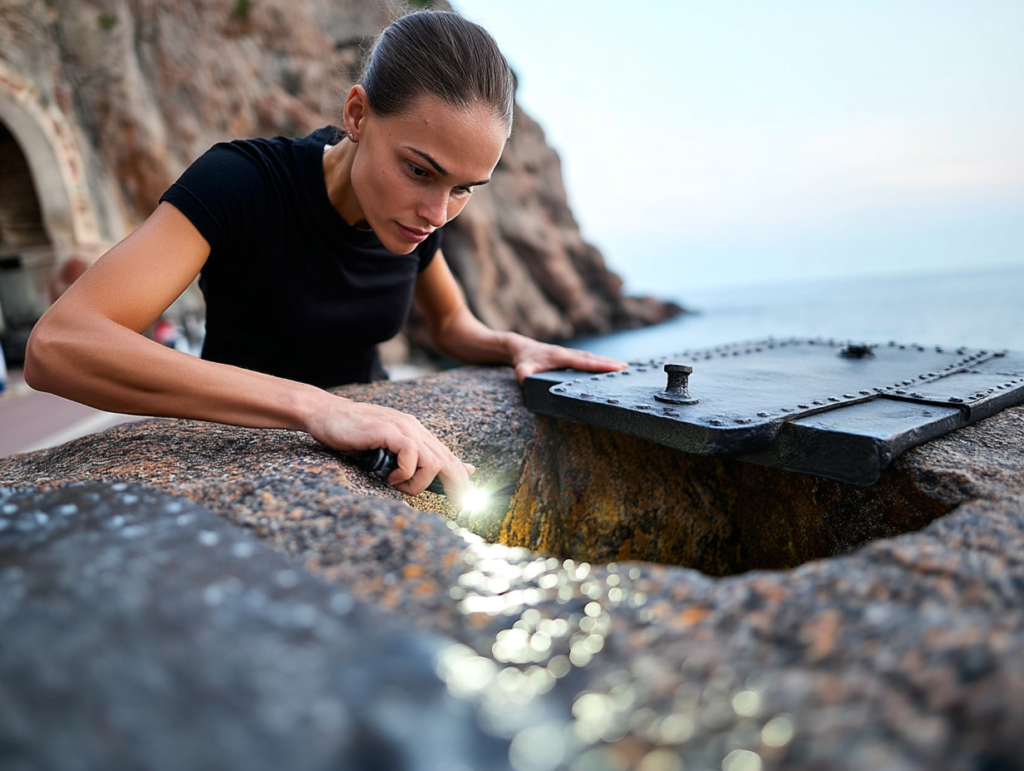
It took both of them to wrench it upward. When the seal finally gave, the hatch opened only a crack, but cold air rose at once, damp and metallic, carrying the smell of trapped seawater. Eli stepped back. Nora only gripped the torch tighter.
She knelt and shone the light through the gap. Iron rungs descended into darkness. Below them lay black water, still at first glance, with scraps of corroded metal jutting from the walls. This was no cave. Someone had engineered this under the reef—built it, sealed it, and left no public record of its existence.
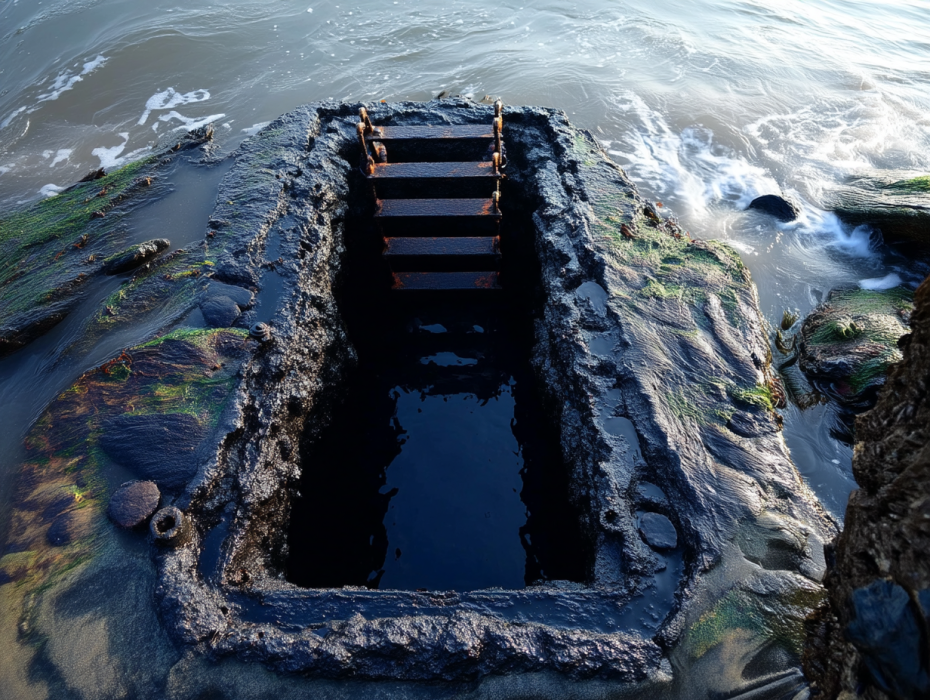
Then her torch caught writing on the wall above the waterline, faint but unmistakable. It was her father’s handwriting, hurried and slanting: If this opens, the village must know. Nora read it twice, and in that instant, the years of rumor shifted. Her father had not been chasing legends. Thomas died trying to warn the village.
The pale trail was water broken by trapped gas escaping through the corroded seams of the iron structure beneath, forced upward along its length by tidal pressure, frothing white as it surfaced. At the main chamber end, the pressure was strongest: the water spun, and on the worst mornings, a section of loose iron casing was pushed briefly upright before falling back.

Once the fear lost its ghostly shape, what remained felt worse. This had not been a curse the village could hide behind. It had been a danger left in place, then dressed in whispers and greed, because then no one would have to be accountable for what was happening and people could profit off the tragedy.
Nora went straight to Cal. She laid the notebook, the bolt, and a photograph of the hatch on his desk and watched the strength leave his shoulders. He did not deny any of it. Instead, he sat down slowly, as though age had found him all at once.

He told her he and Thomas had gone out together the night Thomas vanished. Thomas had wanted to mark the bad stretch before summer visitors filled the cove. They took ropes and a buoy, meaning to do quietly what the harbor committee kept postponing year after year.
Something below had caught their line. The boat jerked sideways. Then the water began pulling harder than either man expected, not in open waves but in a narrow, savage tug that dragged them toward the reef. Thomas shoved Cal free while trying to cut the snag loose.

Cal said the last thing he heard was Thomas shouting that it was all connected under the water. Then the boat struck, the rope snapped, and darkness and spray swallowed everything. Cal lived because Thomas made sure of it. Shame kept him silent after that.
He had gone to the harbor committee twice over the years, unnamed, suggesting the reef needed marking. Both times, the proposal was shelved. Once Thomas disappeared, the Serpent Line gave everyone something easier to repeat, and many were making money off it. On his part, Cal was ashamed he had let down his friend.

Nora called for a meeting in the village hall. She showed everyone Eli’s footage, Thomas’s notebook, and the pictures from beneath the hatch. She spoke plainly. No spirits. No curse. It was only broken remains under the reef, and a patch of sea people should have marked years ago.
Silence held the room after she finished. Mrs. Wren lowered her eyes first. Maggie reached for Nora’s hand. A few villagers still looked stubbornly unconvinced, but most seemed less offended by losing a legend than stunned by how ordinary the buried truth really was.

In the weeks that followed, warning markers went up around the reef. Men from the district came to inspect the hidden chamber and seal what remained below. Boats gave the area a wide berth. If not exactly cheerful, the cove became quieter and steadier.
On her last evening, Nora stood again on the cliff path above Blackwater Cove and watched the tide darken toward dusk. The sea still kept its moods, its shadows, its old power. But the Serpent Line no longer felt like a haunting. It had been something finally named.

Nora left Blackwater Cove, less angry, though never quite at peace. The sea still moved as it always had—restless, unreadable, and older than every story told about it—but now the village had one less lie to sell and one more truth to live with, and for the first time since her father vanished, that was enough.